Robert Bell's
Wines of Canada
Since 1992
Inniskillin Winery
The winery that changed a Industry
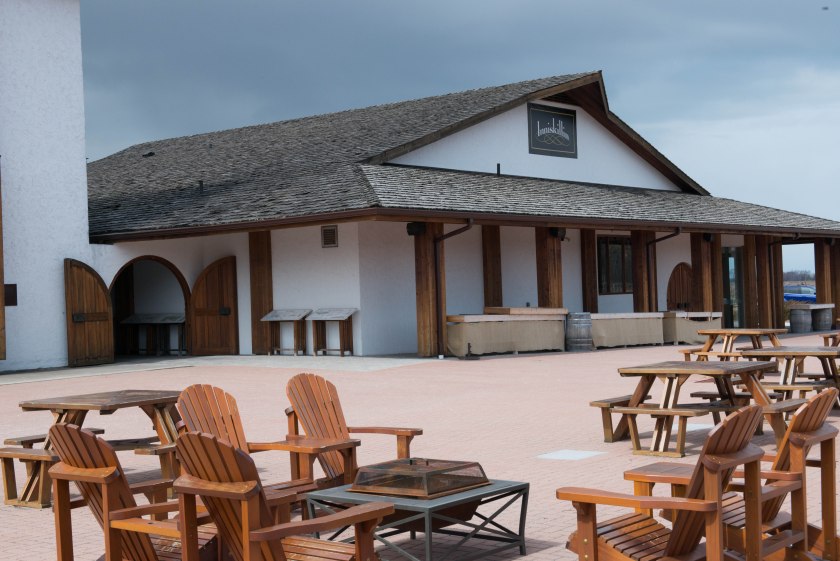
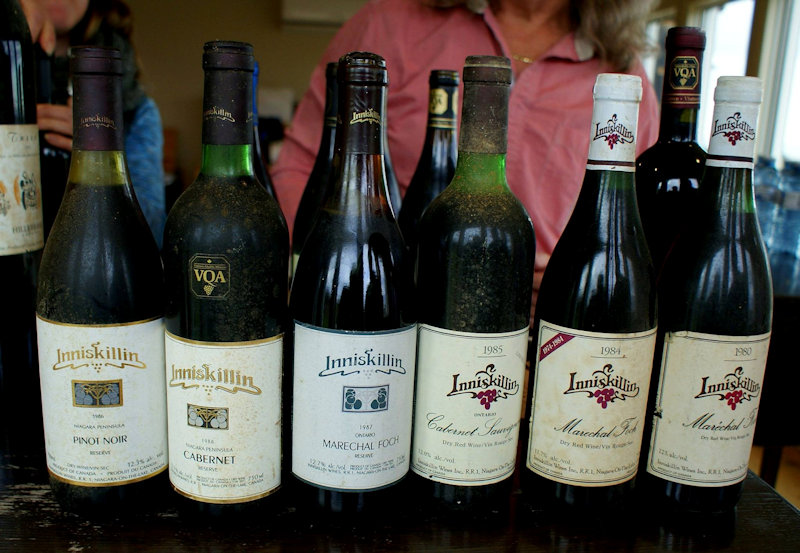
Inniskillin 1984
The early 1970s marked the beginning of a major shift in Canadian winemaking. According to policy research on the industry’s development, this period saw the emergence of two important policy tracks:
Although Canadians had been making wine for more than a century, the idea of producing world‑class wine was still aspirational in the early 1970s. The modern era of high‑quality, vinifera‑based wines wouldn’t fully take off until decades later, driven by a handful of visionaries who believed Canada could compete internationally. Inniskillian was going to change everything~ We can not say they did it alone but their part was a major contribution.
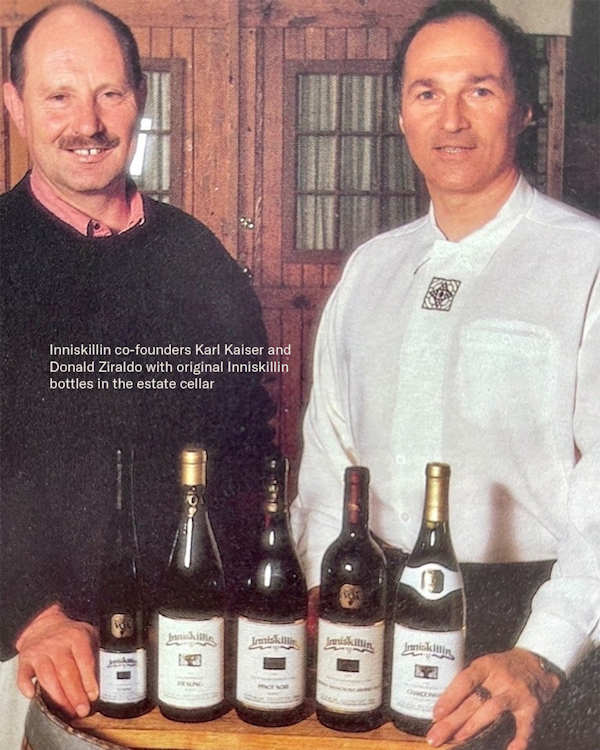
Unfazed by critics, Donald Ziraldo and Karl Kaiser planted Inniskillin’s first vinifera vineyard on Line 3, across from the current Niagara Estate winery. On July 31, 1975, its founders made history when they were given the first winery license in Canada since Prohibition. The original name was Inniskillin House of Wines.
The name Inniskillin is Irish and is derived from the famous Irish regiment, the Inniskilling Fusiliers. Colonel Cooper, a member of this regiment, served in North America in the War of 1812. On completion of his military service, he was granted Crown land which he named the Inniskillin Farm. The first Inniskillin winery was housed in an old packing shed at the family nursery, two kilometers (km) from its current location. As the popularity of their wines grew it was necessary to enlarge the winery 1978, Inniskillin relocated to our present site, The Brae Burn Estate
Kaiser and Ziraldo had two challenges. They need to produce good wines and they needed people to buy them. The initial inspiration came three
years ago. Ziraldo, after graduation from the University of Guelph, was working in his family's nursery and one day became intrigued with the idea of making some wine from some of the special vines he was selling to his customers. A knowledgeable friend, Karl Kaiser, a chemist and winemaker who learned the art in Austria joined Ziraldo.While visiting his in laws in Canada Karl tasted Canadian wine and was not impressed. He knew he could produce better wines.
Russia invaded Czechoslovakia just prior to Karl's return home to Austria; fate would have the Kaiser family returning to Canada settling in St. Catherines. He decided to plant grape vines feeling he could make better wine than the current producers(1). This venture led him to the Ziraldo Nursery where he would eventually meet Donald Ziraldo.He enrolled in Brock University earned his BSc degree in chemistry and biochemistry 1974. He also received an Honorary Doctor of Laws degree from the University in 1994. Upon arriving in Canada Karl Kaiser planted his own grapes and began making wine. He was his attempts to find the right vines that led him to the Ziraldo Nursery and meeting Donald Ziraldo
With help from a man in the back ground, a 29-year-Alain Rigaud,old winemaker from
the University of Dijon, they chose to plant Pinot Chardonnay, Gamay, Pinot Noir and Marechal Foch vinesThe project represents a considerable gamble. "Everybody who looks at it," says Ziraldo, "tells us it's one of the riskiest ventures they've ever seen." There are dozens of imponderables-not the least of which is the question of raw materials. Inniskillin House plans to use hybrid grapes, which are a cross between the vinifera grapes grown in the great vineyards of Europe and a prolific North American variety. One of their> gambles is that they'll be able to obtain a reliable supply of grapes at an economic
price.
There's another big gamble: will Canadians buy the wines they make?
When Inniskillin wines hit the market this fall, they'll be priced in the $3.50 to $4 range-a bit costlier than the cheapest imports. Will Canadians choose an Inniskillin product in preference to an imported wine retailing for around.
The wine won Gold at the 1986 Inter Vin International competition in Toronto.The icewine chapter came in 1983 when Karl Kaiser, Ewald Reif (Reif Vineyards), Hillebrand and Pelee Island all agreed to put aside a small portion of their vineyards aside and attempt to make icewine. With the help of netting Inniskillian was able to produce a 1984 vintage with a label that read Eiswein Vidal (ice wine). The wine won Gold at the 1986 Inter Vin International competition in Toronto. The wines were good but it was up to Ziraldo to sell them.
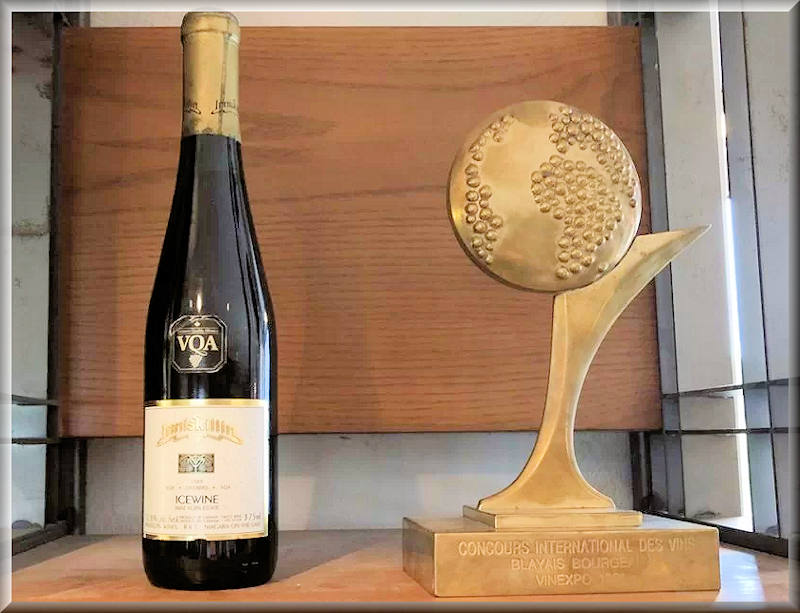
In 1984 Inniskillian produced their first Icewine. the first attempt in 1983 went to the birds -- literally. Pivoting to netting protected the crops in 1984 and beyond. Inniskillin went on to be one of the worlds best producers of Icewine.
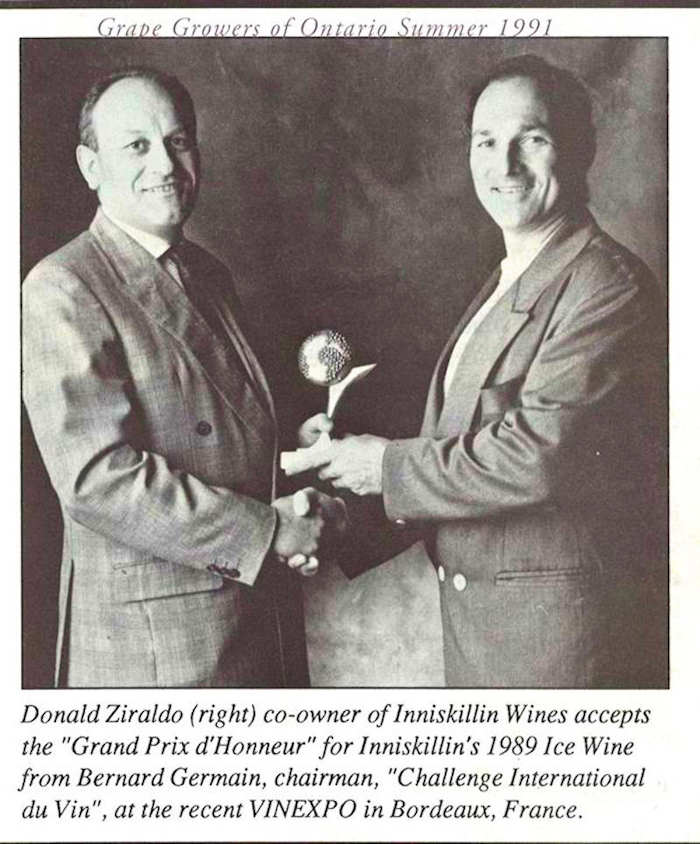
Karl's wife Silvia said winning Grand Prix d'Honner was like winning the Olympics and Academy Awards together. Not only was the award significant for Inniskillin Wines of Niagara-on-the-Lake, it proved to be a turning point for the Canadian wine industry. Karl, an early pioneer of Icewine production in Canada, has proved to be one of the industry's formidable talents. Karl's Icewines have won a myriad of international awards and honours, and he repeated the Vinexpo coup once again. He has excelled not just in Icewine production, but also his other passion – Pinot Noir. But it is to Icewine that Karl is inexorably linked.
Led by founding chair Donald Ziraldo, VQA (Vintners Quality Alliance) was established in 1988, ensuring quality and credibility in the region.
By the 1990s, Inniskillin’s Icewine had exploded in global recognition—especially after winning the Grand Prix d’Honneur at Vinexpo in 1991, which put Canadian Icewine on the world map. This level of growth required capital, distribution networks, and infrastructure far beyond what two founders could sustain independently. They sold Inniskillin to become part of Vincor International
Bruce Nicholson served as Winemaker for Inniskillin Niagara, taking over after the legendary Karl Kaiser retired. This was a significant transition — Kaiser had been the founding winemaker — and Nicholson was chosen because of his deep technical skill and long experience with cool‑climate wines.
Donald Ziraldo, Karl Kaiser, along with team members Debi Pratt and Gerald Klose have been presented with the Canadian Wine Industry Award of Distinction by Wine Growers Canada. Klose is recognized alongside Ziraldo, Kaiser, and Debi Pratt as one of the individuals whose early work helped propel Inniskillin from a small Niagara startup into a nationally influential winery. It’s the highest form of peer recognition in the Canadian wine industry.
Pratt was standing beside founders Donald Ziraldo and Karl Kaiser when Inniskillin received its historic 1975 license — the first winery license granted in Ontario since Prohibition.
She became involved in the early 1970s while still working as a schoolteacher, drawn into the project through Ziraldo and Kaiser’s vision. Pratt became the public face and communications anchor for Inniskillin for decades.
Her long tenure as Winery Public Relations Manager is documented in professional records.
Her work helped shape not only Inniskillin’s brand but also the broader public understanding of the emerging Canadian wine industry.In 1994 Inniskillin Okanagan began as a collaboration between Inniskillin and the Osoyoos Indian Band (Okanquen Tribe). The label design reflected the heritage of the land.
In 1999 The Inniskillin Hall at the Cool Climate Oenology and Viticulture Institute (CCOVI) opened at Brock University. This is the training ground for some of our future winemakers.
Arterra Wines Canada squired the winery in 2016.
Sources
Donald Ziraldo
Michael 'Vaughan -Toronto Life 1975
Inniskillian
If you enjoyed this website and want a way to support me, you can help by advertising on our web page. See our new wedding page.
Home | About | Sitemap | Support |Facebook| Contact Us |©2026 Robert A Bell
Wines of Canada was developed and designed by Robert (Bob) Bell of Whi make or sell wine. Support is welcome as are suggestions and comments; should you see something that needs to be corrected please let us know.