Robert Bell's
Wines of Canada
Since 1992
The Names Behind Winemaking in Canada
A work in Progress!
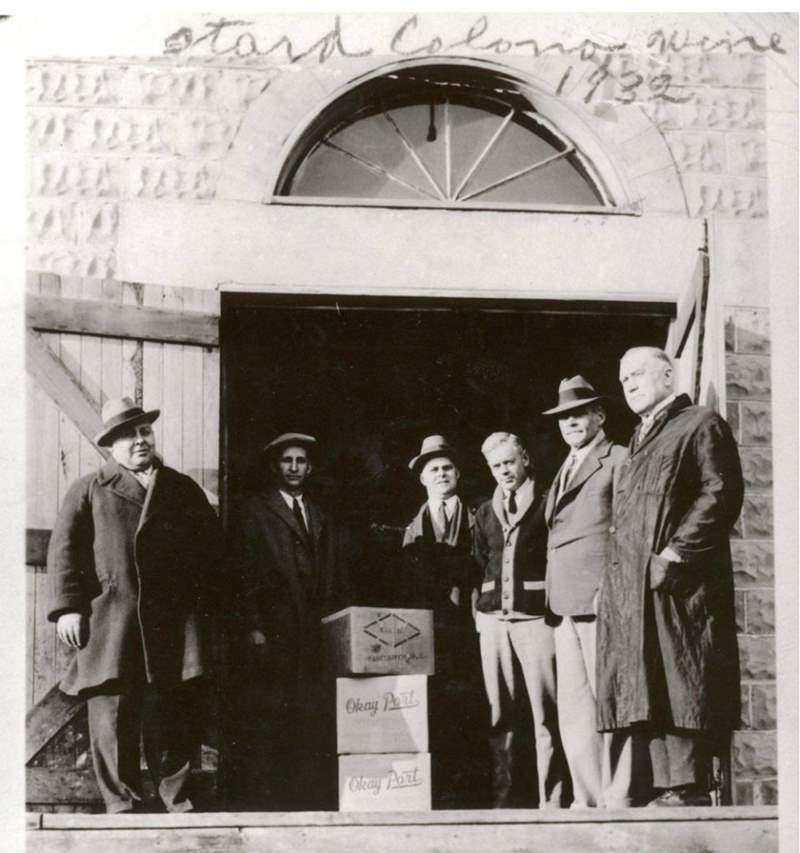
Calona Wines -1932
Louis Hébert was born in Paris in 1575, By 1600 Louis was established in Paris as an apothecary and spice merchant. In 1606, he accompanied his cousin-in-law, Jean de Biencourt de Poutrincourt et de Saint-Just, to Acadia, along with Samuel de Champlain. He lived at Port-Royal (now Annapolis Royal, in southern Nova Scotia) from 1606 to 1607 and from 1611 to 1613 when Port-Royal was destroyed by the English. It is stated that on his second vsit to Nova Scotia he planted vines.
Johann Schiller is considered to be the father of commercial wine making in Canada. He was a retired soldier who domesticated the wild vines that grew along the Credit River in Cooksville, Ontario. By 1811 he had added American Hybrids from Pennsylvania making enough wine to sell.
Marguerite Bourgeoys, C.N.D., was the founder of the Congregation of Notre Dame of Montreal in the colony of New France, now part of Québec. She lived in Fort Ville-Marie (now Montreal) as of 1653, educating young girls, the poor, and natives until her death at the turn of the 18th century. She is also significant for developing one of the first uncloistered religious communities in the Catholic Church She has been declared a saint by the Catholic Church. She is known to have made Cider and may have been the first to do so in Quebec and Canada.
Francois Dollier de Casson ( the leader ) and Rene Brehant De Galinee two Sulpician priests in the company of 7 soldiers paddled their 3 birch bark canoes from Montreal departing in July of that year with the intention of reaching the Ohio. In 1669, Dollier and Galinee traveled along the Lake Erie shoreline and arrived in Port Dover where they established their ... winter camp and discovered the local grapes. They made wine that was described "as good as vin de Grave".
Datus Kelly in 1842 brought Isabella and Catawa vines from Ohio to Kellys Island 12 miles south of Pelee Island. In 1833 Datus and Irad Kelley began buying parcels of land on Cunningham Island in Lake Erie, which was renamed Kelley's Island. In 1836 Kelley moved to the island and spent the rest of his life developing the island.
Charles Carpenter In 1850 made wine from these grapes. 8 years later a number of vineyards had been planted on South Bass Island.
Henry Price may have been the first to plant vines Pelee Island 1854
Achilles Roumegous established around 1855 in Cookville Ontario. In 1857 they took over Clair House
Henry Parker planted vines at the Clair House Lot 17 near Cooksville in 1858. He joined forces with Justin De Courtenay to produce commercial wine. The Canadian Vine Growers Association was formed to sell the wines. 1860 By 1864 De Couteny was in charge producing wines from the Clair House. At the height of production in the mid-1860s, Clair House produced as much as 50,000 gallons of wine and a considerable amount of brandy. In 1926 Fred C Marsh took over The Canadian Vine F Growers assets. Cooksville was one of the founding villages that amalgamated to form the City of Mississauga.
Count Justin M.de Courtenay purchased Johann Schiller's farm and by 1864 had doubled the size of the vineyard by planting Clinton and Isabella grapes. His wines had the brand name Clair House.
Justin De Courtenay One source states that De Courtenay bought the Schiller property and other source say the Cooville vineyard property and Clair House was sold in 1865 to Charles Day. Day, together with Sir Melville Parker and Count Justin M. de Courtenay (who was brought in to manage the vineyard), founded the Canada Vine Growers Association in 1866 – the first commercial winery association in Canada. De Courtnenay was an Englishman with experience in European vineyards. He brought in Gamay, Clinton and Isabelle grapes.
Under de Courtenay’s management, the winery and vineyards prospered. The estate house, which had been built by Henry Parker, was re-christened as “Chateau Clair”, and the wine was sold under the label of “Chateau Clair Wines”. The vineyard grew to encompass more than 88 acres of land, and Chateau Clair Wines won first prize in the 1867 Paris Exposition and the 1876 Philadelphia Centennial. Vines from Chateau Clair are also historically attributed to saving the wine industry in France. In the 1860s, French grapes were attacked by blight, to which controls proved ineffective. Count de Courtenay is accredited with sending grape vines from Chateau Clair, which proved to be resistant to the disease, to France to revitalize French vineyards. Many of the world-famous French vineyards today owe their establishment to vines grown in Cooksville by Johann Schiller.
In 1867, David Jackson Lowrey purchased the farm that is now Ravine Vineyard Estate Winery. His family moved from Vanessa, Ontario to St. Davids and subsequently planted 500 vines on the Upper Lowrey Farm in 1869 — making the family the first commercial vineyard owners in the area.
Solomon White bought the property in 1869, and under his direction the vineyard thrived. Nicknamed “Squire”, Solomon White focused winery production on red and white wines and brandy. The property sold a number of times and it failed as a commercial winery. 1932 the 86-year-old estate, Chateau Clair, was razed by fire. Later that year, Clarkson sold the property to Ernest Webb, who demolished the remains of Chateau Clair and the vineyard in 1935 to make way for new construction.
Issac de Razilly head of the French colonists at Fort Ste. Marie-de-Grace (near present day LaHave in Nova Scotia) he wrote in 1634 I have planted some vines as they do in Bordeau which have come along very well. De Razilly became known as the Father of Acadia. Wild vines grow in Nova Scotia, it is unknown if he referred to native vines or vines brought from France.
William Cunard a grape grower in the mid 1800's in Nova Scotia
Aaron Hovey Jr evidence suggest that Hovey a resident of Upper Miramichi Rural Community, New Brunswick
produced commercial wines sometime between 1809 and 1841. His homestead is a Local Historic PlaceAbraham Hebb a grape grower in LaHave River Valley, Nova Scotia around 1850. He grew a variety called Diana
Charles H Heaton came to Pelee Island in 1870. Among other occupations he grew grapes at Lot 34 South Bay Road. In 1898 he won first prize fro his dry red at the Pelee Agricultural Society fair. Although no physical evidence remains of the winery that Mr. Charles Heaton once owned, it is believed to have been located north of Mill Point on the east shore. In 1870 Heaton moved to Pelee Island from South Bass Island with his wife and four children. In the early years he practiced as a carpenter while clearing his land of woods and planting grapes. In 1898 Heaton won first prize for his dry red wine at the sixth annual Pelee Agricultural Society fair. Prior to 1905 Heaton had made wine which was marketed to Canada and the United States. Like other grape growers, Mr. Heaton pursued many types of enterprises. Fishing, cutting wood, trapping and cultivating potatoes, corn, beans and turnips as well as grapes offered Charles Heaton a means to make a living. But by 1886 Heaton sold ten acres of land to James Findlay and little else is known about Mr. Heaton's contribution to the economy of the island including the wine industry.
Porter Admans a winery brand started in the 1860's located in Niagara. They mostly sold the juice to home wine makers


Archilles Roumegeous in 1857 opened a winery in Cooksville, Ontario he sold it to the Marsh family in 1890, who moved the winery closer to Niagara Falls naming it Stamford Park Wine Company which was later acquired by Canadian Wines Limited who in 1940 became Château-Gai
Father Pandosy is referred to as the Father of the British Columbia wine industry, he planted vines at the Oblate Mission near Kelowna in 1859. Oblate missionary Charles John Felix Adolf Marie Pandosy in 1859 arrived in the Okanagan to establish a mission, the first permanent non-native settlement in the British Columbia Interior other than Hudson's Bay posts. "The tillable land is immense," he wrote in his first report to his superiors that October. Credited with planting the first vines in the Okanagan, his name was memorialized as a label for a line of wines produced by Mission Hill in the 1980s. But while the mission farm included the first vines in the Okanagan, viticulture was no more a priority than growing vegetables. The often-repeated claim that Father Pandosy was the founder of the British Columbia wine industry is fanciful. There is no record that he ever sold a bottle of wine.
He was born at Margerdies, a village in Provence near Marseilles, son of a land-owning family; after considering a naval career, he joined the Oblates, an order which had been founded two years after his birth. (The full name of the order is Congregation of Missionary Oblates of Mary Immaculate -- oblate meaning one who offers himself.) In 1847 he was among a group of Oblates who left France as missionaries to the natives in what is now Washington state. Between 1848 and 1855 there was a series of wars between settlers and Indians, during which American militia, believing the priests in collusion with the Indians, burned one of their Washington missions. The Oblates then closed their other missions in the Washington interior and Pandosy led a group of missionaries to the Okanagan in 1859, opening a new mission just east of modern-day Kelowna the following year.
In one letter Pandosy described the mission site. "It is a great valley situated on the left bank of the great Lake Okanagan and rather near the middle of the Lake.... The cultivable land is immense and I myself believe that if Fr. Blanchet [a fellow Oblate in Oregon] is able to send us next year, some vine cuttings we shall be able to start a plantation, for when Bro. Surel arrives, if he accepts my plans, we shall elevate our little demesne to the middle of the plain, against a little hill very well exposed.... " With the exception of two postings to Vancouver Island (1860-'63) and Fort St. James (1882-'87), Pandosy spent the remainder of his life in the Okanagan, having become the superior at the mission. "He was a huge, powerfully built man with a booming voice and ready wit," local historian Primrose Upton wrote. "He had large deep-set eyes, well-marked eyebrows, long straight nose, high scholarly forehead, curly black hair and a full beard. He had a very hot temper and was capable of amazing feats of strength, yet was gentle." Upton relates an anecdote of how he frightened off some natives that surrounded his tent during his first night in the Okanagan. He took a butcher knife, cut a target on a tree and from several paces, proceeded to throw the knife to the target three times. Suitably awed, the Indians withdrew quietly.
Sources: "The Establishment of Okanagan Mission" by F.M. Buckland, in Okanagan Historical and Natural History Society, first report Sept. 10, 1926, p. 8; The History of Okanagan Mission by Primrose Upton, published in 1958 by the Okanagan Mission Centennial Committee; "Father Pandosy OMI" by Primrose Upton in the Okanagan Historical Review, 26th annual in 1962, p. 141; "Father Pandosy OMI," by Denys Nelson, Okanagan Historical Review, second annual report, 1927, p. 12.
Father Pandosy MissionJohn Killborn winemaker producing wines in Beamsville in the1860's
W W Kitchen lived in Grimsby Station, in the 1860 he was growing grapes. He stated in the New York Moore's Rural New Yorker ( an agricultural and family) newspaper that he grows over 1000 vines of different varieties. He liked Delaware best. He sold the wine by the gallon. He also suggest he made wine from frozen grapes.
Pierre Dominic Laurent, a French priest from Nantes, Amherstburg Echo newspaper planted the first vineyard on the Essex County mainland in 1867 in Amherstburg, to prepare his own sacramental wines, and his successful trial encouraged others to do the same.
Henry Rehberg' came to Pelee Island in the early 1880's. His farm was described as "...in two years, has changed from an eyesore to a beauty spot, which has been further enhanced by his neatly painted buildings. He has three acres of grapes and [intends to plant] ten acres in the spring." But by the year 1888 Henry has second thoughts about remaining on Pelee. That year his farm was put up for sale comprising of sixty acres, twelve of vineyards and twenty seven of other cultivated land. The asking price was eleven thousand.
George Barnes built a winery in St. Catharines in 1873. He called the "Ontario Grape Growing and Wine Manufacturing company. later renamed Barnes Winery. He sold it in 1932 to Grimsby Wines Ltd. the brand name lasted until the late 1980's
David Jackson Lowery [Lowrey] was born at Ancaster on June 10, 1824 to Matthew Lowrey and Hannah Kelly. He married Elizabeth Catherine Teeter and had 9 children. He passed away on 27 June 1901 in St. Davids, Ontario, Canada. His wife Elizabeth Catharine was born at Virgil Jan 20, 1826 and died Jan. 11, 1911. David Jackson Lowrey, bought the Upper Farm and moved his family from Vanessa, Ontario to St. Davids in 1869 where he planted one of the earliest commercial grape vines. The next generations would continue growing all kinds of tree fruits and grapes. He also donated land to a new one-room stone school which was built in the village of St. Davids in 1871. Ravine winery sits on the property today.
F.A. Shirriff co-founder of Niagara Wine Company in 1874 which later became T.J. Bright Winery
Thomas Bright co-founder of Niagara Wine Company
Thaddeus Smith and Thomas S Williams who were from Kentucky and J.D Williams from Windsor started growing grapes on Lake Erie's Pelee Island in the 1850's. They opened Vina Villa Winery in 1871 and hired J.S Hamilton, a grocer, as their agent.
J. S Hamilton a grocer who entered the wine industry as an agent in 1871 soon opened his own winery, Pelee Island Wine and Vineyard Co. The Pelee Island Wine and Vineyards Company amalgamated with J. S. Hamilton and Company in 1919 to become J. S. Hamilton and Company Limited with Mr. Hamilton as president and managing director. J. S. Hamilton died in March 1931 but the business continued under his name until 1945 when London Winery Ltd. acquired the company.
Edward and John Wardroper planted a second vineyard on Pelee Island, and launched their own operations under the name, Pelee Island Wine and Vineyard Company.6 According to the n
Pierre Antoine Robinet and his partner Ernest Girardot 1879 established a winery in the town of Sandwich (Essex county) Ontario. The business was successful. Between 1879 and 1935 three generations of the Robinets were engaged in the wine business. In 1881 Pierre's son Jules Robinet bought the business.

Jules Robinet
Jules Robinet Jules emigrated to Canada from Rougemont, France in 1875. His family had been in the business of winemaking in the Nans area of France for approximately 500 years. His father Pierre Robinet had actually established a wine business with his partner Ernest Girardo in 1879 in the town of Sandwich, Ontario. Jules bought out his father and M. Girardot in 1883, becoming the sole owner. In that year he produced 25,000 gallons of wine. He also bought most of the grapes in Essex County and shipped them to wholesale merchants in Montreal, PQ and Winnipeg, MB. On April 5, 1893 the Essex County Grape Growers Association was established to represent the interests of those growers in government circles. Jules was elected to the committee to draw up their constitution and by-laws, and was part of the contingent to Ottawa to meet with Agricultural Minister Foster and other MPs to enlist support for the objectives of the association. On May 10, 1895 he expanded and established "Jules Robinet & Company" with financial assistance of John Curry and Alex Cameron.
On January 28, 1897 he established "La Cie Robinet et Freres de Sandwich". His company was incorporated with capital in excess of $50,000, a slate of officers, a board of directors, and statutes. Jules was elected President and Manager, his brother Victor Vice-President. The company offices were located in his own building in the St. Antoine block (corner of Mill and Sandwich Sts.) in Sandwich.

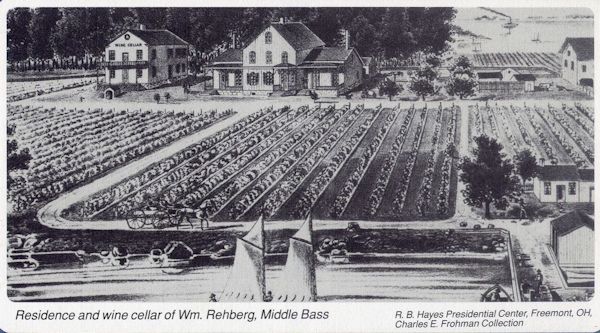

Jules Robinet in his vineyards
This company continues until April 28, 1914 when he buys out his brothers' shares and once again takes complete control.
In 1915 Jules' sons, Clovis and Joseph, enter into partnership with their father, and in 1920 his sons Frank, Paul and Emile also join the company. The company is then called "Robinet and Sons".In 1920 Jules brought over two experts from France to develop the process of making Champagne with local white grapes. With prohibition in force selling this wine was difficult.
In July of 1928 Jules establishes a new winery in his sons' (Clovis and Frank) names. This company located in Oldcastle, Ontario is called "Robinet Freres" and it is this company that T.G. Bright & Company buys from Jules in 1935. That same year he sold the original winery to Fred Marsh. At one time five of his son Joseph, Francis Paul, Emile and Clovis were involved in the companies of Jules.
Finlay Winery (John Finlay) constructed a cellar in 1888. A house was constructed over the cellar. The cellar would hold at least 10,000 gallons. Fire damaged the cellar in 1893, it was rebuilt in 1894 and final improvements were made in 1895.
James Srigley a grape grower on Pelee Island in the 1880s
John and Edward Wardroper were planting grapes by 1880 on Pelee Island
Fred C Marsh Established the Stamford Park Winery 1890 In 1929 formed Fred Marsh Winery Limited at Niagara Falls
W.J. Wilcox believed to be the first commercial grape grower in British Columbia starting a vineyard near Salmon Arm around 1891
1911 The Kentville Experimental Agricultural Research facility opens in Nova Scotia
1918 Pietro Beiluz founded Twin City Wine Co in Fort Williams sold to Brights in 1956
Capozzi grocery store 1918- from Oldphotos.ca1918 photo showing the interior of the Capozzi's grocery on Bernard Avenue. Pictured is Pasquale (Cap) Capozzi in his store The City Grocery (later called Capozzi's Cash Grocery).Here is some more background info from the Kelowna Italian Club website: "Pasquale (Cap) Capozzi arrived in Nelson in 1907. After three years working numerous jobs he made his way to Kelowna and opened Capozzi’s Cash Groceries on Bernard Avenue. After his store was well established he became involved as an agent for many of the farmers in the area. This led him to join his neighbouring store owner, W A C Bennett, in forming a winery, using apples grown in the area. The switch to grapes proved more successful with the resulting Calona wines established in 1931. One of Cap’s landmark development projects was the Capri Hotel and Shopping Centre. In 1921 he married Maria Mussatto and they raised three sons Joe, Herb and Tom.
Early grape growers in BC Okanagan Left to Right: Gisachano (Joe) Lanfranco, Silvio Vaccaro, Camillo Rampone, Vincenzo Rizzo, Angelo Pioli..taken in the 20’s..they were admiring the grapes that had been planted
Packing Grape Baskets - circa 1930.
View of J.W. Hughes standing handing a basket of fresh market grapes to Walter Born, who is standing on top of an International truck with a 1929 license plate at Pioneer Vineyard.
From a series of vintage photos displayed on a wall at Orchard Park Mall - Kelowna


J. W Hughes harvesting grapes
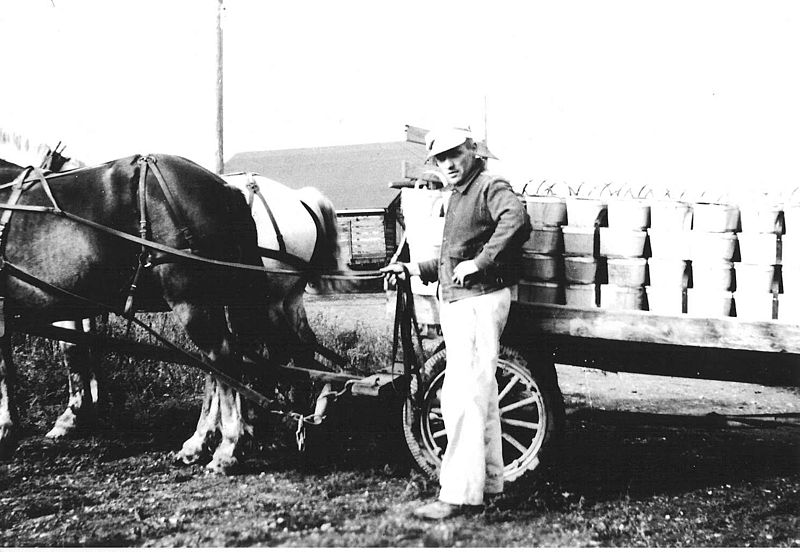
J.W Hughes grew the first large scale commercial grapes in the Okanagan in the late1920's selling to wineries. He obtained his first vines from Wilcox Vineyard in Salmon Arm and from Ontario. He started growing grapes in 1926, expanding from 45 acres near Okanagan Mission to 75 acres by 1933, and eventually had over 300 acres of grapes in production. He was one of the earlier growers in the Kelowna to produce grapes, which has become a leading agricultural industry. Hughes also grew cucumbers, asparagus, raspberries, and flowers, sold vegetable seeds and experimented with game and poultry farming in the 1940s. Hughes sold most of his vineyards to men who had worked for him, and shifted to growing and sending gifts of flowers to hospitals and shut-ins in BC and Alberta through the Rotary Club. Over the years, until his death in 1975, he sent about two million peonies, tulips, and gladioli.
In 1930 the first grape contracts -- the agreed price was $100 a ton -- were signed by Hughes with Victoria Wineries Ltd. The credit for contracting the first grapes usually goes to Growers' Wines Ltd. because it acquired Victoria Wineries at this time.
W. Hughes House 806 Bernard Avenue, Kelowna A Heritage Designation Bylaw protected this house in 1995, giving it value as an early participant in the City's heritage conservation program
Hughes built this substantial house himself in 1933, at the height of the Great Depression, when building a house was a bold gesture. The design of the house has value for being characteristic of architecture between the world wars. It is one-and-one-half-storeys high, with a large forward-facing dormer and projecting porch. Jesse and Ruth Hughes lived here until the mid-1950s, when they retired to their remaining property in Okanagan Mission.Henry Dennis Powell Born in Portland, England, and raised on his grandfather's diary farm, Powell came to Canada in May, 1928. In Winnipeg, where many immigrants disembarked from the train to register for work, Powell was recruited by J.W. Hughes, who gave him a summer job as a teamster on Hughes's Pioneer Ranch near Kelowna. The next spring Powell was rehired by Hughes and, by 1931, was a foreman on the Pioneer Ranch, so named because it had been a large cattle ranch. "He was tight," Powell said of Hughes, "but if you didn't like what he paid, you didn't have to work for him." Apparently satisfied with what he was offered, Powell received 12.5 cents an hour when he started and doubled his salary when he became foreman. In 1944 Powell became the first of Hughes's foremen to agree to terms for purchasing a thirty-acre vineyard portion of Pioneer Ranch over seven years. The vineyard had been planted with number of labrusca and hybrid varieties, among them Campbell's early, sheridan and patricia, hardy plants to survive the Kelowna cold. "The winters seemed colder then than now," Powell said years later. "You could sit in the house and hear the [frozen] stalks crack -- like the crack of a rifle." Even when the shattered trunks died, the vines regenerated from the roots. Powell and his son, Den Powell, continued Hughes's practice of selling many grapes into the fresh market as well as to wineries. They also replaced many of the older varieties with the hybrids more in demand for winemaking. "That's what the wineries want," the elder Powell told a Kelowna newspaper in October 1981. "It's getting pretty scientific now and sometimes I feel like we're getting left behind." But after the 1988 vintage, the wine grapes, which made up half the vineyard, were removed, leaving primarily table grapes, with Den Powell devoting himself to operating a trucking business and raising cattle.
Kentville Research Station Opened in Nova Scotia,1911 by Federal Government under the name Dominion Experimental Farm. Kentville Research facility first studied grapes in 1913. They evaluated grapes testing 175 wines and grapes from 1931- 1983. Today under the name Atlantic Food and Horticultural Research Centre they continue to work with Nova Scotia wineries
Hugh Fraser was born in Montreal in 1885. He took part in WWI stationed in France until he was captured by German troops in 1916. When Armistice was signed in 1918 Major Fraser was released from his prisoner-of-war camp. He returned to Canada and accepted an invitation from a friend, Naramata playwright C. C. Atkins, to visit the Okanagan. He loved the wild, scenic valley — it was a perfect fit for his outgoing personality — and he soon purchased the Hawthorne Ranch. Here he raised dogs and planted vines. The ranch was his home for more than 45 years, each year adding to a rich mix of truth and fiction involving elaborate gatherings, plenty of dogs and a wife from London, who upon seeing the rustic surroundings left both the Valley and a three-word note: “See ya later.”
Dr Donald L Craig did much of the research at the Kentville Station.
Herbert Anscomb headed the Growers Wine Company from 1922-1955. juggled business with a long political career: he was Reeve of Oak Bay, then mayor of Victoria and sat from 1936 to 1952 as a Conservative in the British Columbia Legislature. As the province's Minister of Finance from 1945 until 1952, he introduced the province's first sales tax, three per cent, in 1948. As a cabinet minister, Anscomb ensured that his winery's products enjoyed secure listings in government liquor stores. Anscomb's political links with the government in Ottawa also enabled Growers' to get a distillery license in 1936, then the only Canadian winery with that privilege.
Knowles Family founded London Winery 1924

 |
Born in 1877, Rabbi Jacob Gordon was Dean of the Toronto Rabbinate for 30 years Rabbi Jacob Gordon (1923) received a license to manufacture Passover Wine in his home cellar. His license was purchased in 1928 by the Oporto Wine Co. Which after a serious changes led to the Parksdale Wine Ltd in1936 |
Bennett, W.A.C. (1900-1979): The non-drinking premier of British Columbia from 1952 to 1972, Bennett paradoxically was an investor in and president of Calona Wines Ltd. in its initial years. Bennett, who bought a hardware store in Kelowna in 1930, had become a close friend of Cap Capozzi, whose Bernard Avenue grocery story was just three doors away from the Bennett store. Bennett and Capozzi traveled the province in the early 1930s, selling shares in the winery. The non-drinking Bennett was being strictly entrepreneurial: he saw the winery creating jobs as well as markets for local fruit. He resigned in December 1941, writing Cap Capozzi: "Now that I am elected a representative in the Provincial Legislature, and as Calona Wines does a considerable proportion of its business with the provincial government, I do not think it would be proper for me to retain a financial or directing interest in the company. As you know, I have sold all my shares ...." Bennett had accumulated 5,237 shares; they were sold to a businessman named Gordon Finch.
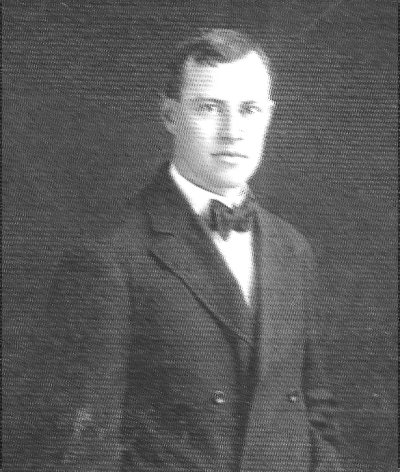
Harry Hatch CEO T.G. Bright and Company
Harry Hatch purchased Canada's largest winery T.J.Bright in 1933. In 1923 he had purchased Gooderham and Worts Distillery and in 1926 had enough funds to buy Hiram Walkers becoming one of the most successful and wealthiest men in Canada. The Toronto Star dubbed him King of Canadian Distillation Under his leadership at T.J.Bright Vinifera hybrides were imported from France. In fact over six hundred varieties were tested.
Dr John Ravenscroft Eoff III was Harry Hatches' winemaker who introduced microbiological control to the Canadian wine industry.
Dr Donald L. Craig tested over 175 grapes at the Kentville Research Station, Nova Scotia from 1932 t0 his retirement in 1983. Researcher Helen Fisher supplied cuttings of Ollie Brant selection V.53261 to be evaluated by Dr. Don Craig at the Kentville Research Station. This selection was orphaned in Ontario, and after successful evaluation in Nova Scotia became the award winning wine variety named L'Acadie ~ the wine L'Acadie Blanc.
Alexander Robert Stirling (1900-1996) took over the family farm in Greenwich and eventually devoting much of his life to growing fruit. Within a few years of taking over the farm, Sterling was operating a dairy – the Willow Hollow Dairy in Greenwich. On the same site he constructed a warehouse with an apple grader and this was his start in growing and marketing apples. Stirling soon was shipping apples to Maritime ports and as far away as England, all apparently within a decade or two of his taking over the family farm. In many ways Stirling was a pioneer, not only in the growing and marketing of fruit but in introducing many agricultural firsts to Nova Scotia. On the site of his dairy, Stirling built a warehouse with an apple grader and a cider press where he produced and marketed Red McIntosh Apple Juice. Nearby, Stirling set up a cannery under the brand name Annapolis Valley Canners, producing canned small fruits, salad dressing and chicken. Today his grandson produces Stirling Cider.
Nicola Pataracchia self taught winemaker founded Thorold winery 1922. He sold Thorold in 1927 merging five wineries which would later become Chateau-Gai in 1940. Won a gold medal for his sherry at the Bologna World Exhibition 1933 working at St Catherines Wine Co.
Frank SchmidtFrank Schmidt, (1913-1979):An early Okanagan grape grower. Born in 1913 in Unity, Saskatchewan , he emulated many other farm lads during the Depression by hopping a freight train, arriving in Kelowna in September 1937 for the vintage. Schmidt did such a good job picking grapes for pioneer grower Peter Casorso that in 1938 Schmidt was given a contract to manage a vineyard, along with a house to live in. Four years later grower J.W. Hughes lured him with an even better package: a house, a car and $100 a month. Subsequently Hughes let Schmidt (and the other vineyard foremen) earn ownership of the vineyards they managed. In 1958 Schmidt became the owner of Lakeside Vineyards, later renamed the Beau Séjour Vineyard, at Okanagan Mission, south of Kelowna on the east side of Okanagan Lake. He retired after the vineyard was sold to Growers' Wines Ltd. of Victoria in 1965. In 1977 he became the first Life Time Member of the Association of BC Grape Growers.
Schmidt had a warm and favoured relationship with Growers' and its general manager, Brian Roberts . When the Victoria winery, which had been shipping fresh grapes from the Okanagan since 1932, decided to crush them in the Okanagan and ship the must instead, the crushing equipment was installed on the Schmidt vineyard and Schmidt was paid for operating it. "We could have located the crushing depot on neutral soil, but deliberately located it on your farm so that you could get major benefits," Roberts wrote. In January 1960, when Ernest C. Warner bought Growers', Roberts again wrote, offering a benefit: a small number of class B voting shares -- never before available -- were being offered to friends of Warner and of the winery. "My thought is that the Company's good friends in the Okanagan -- the gentlemen who have been growing the grapes for us all these years -- might just want to have a few shares in the Company to give them not only a splendid investment, but also a greater interest in the Company which turns their grapes into wines which are sold as far as Ontario and the Yukon. ... I will lay my head on the block that the share right now is worth every cent of $10.00, so that it is not really a speculative share." Both Schmidt and his son, Lloyd, became shareholders.


Lloyd Schmidt, son of Frank Schmidt was born in Kelowna He worked with his father in their vineyards. As Frank became ill Lloyd gathered more and more responsibility. After graduating from Pittman Business College., he worked as assistant to John Vielvoye BC grape specialist. He also worked as Viticulturist for six years at Cascebello wines. In 1981 Lloyd and his wife Noreen co-found Sumac Ridge. In 1987 they sold their Okanagan interested and moved to Ontario, Niagara region, where they established International Viticulture Service. They retired in 2012
Tom Capozzi, After being made a director of Calona Wines in 1958 and then becoming vice-president and general manager, Tom brought modern marketing to the winery by the simple strategy of going to California at least once a year in search of ideas. He admired especially the Gallo Brothers and appropriated their packaging and product ideas for the better part of the decade until he was inspired to propose a partnership to them in 1969. When they met at the Gallo offices in California, Ernest Gallo thought the idea had merit -- with conditions. Gallo offered to buy a fifty-one per cent interest in Calona with no payment other than lending the Gallo name to the venture. Tom Capozzi angrily retorted: "Mr. Gallo, if I had wanted a job as a salesman for Gallo Wines, I'd have filled out an application."
Adhemar de Chaunac a microbiologist hired by Dr. Eoff. In 1938 he was the first to introduce Vinifera hybrides into Canada. He imported Maréchal Foch, Baco Noir, Chardonnay, Riesling Pinot Noir and Gamay from France (approx 1946). These wines first appeared
Gottfried Hernder emigrated from Germany to western Canada. In 1939, the family moved to the "Grapeview" area of St. Catharines, Ontario, to a mixed fruit farm that included acreage of indigenous grapes. "Fred" Hernder's boyhood chores would become the foundation for future skills. After the passing of his father, Fred purchased the family farm in 1968, and began the acquisition of others. His success was heralded when he was crowned as the youngest Niagara "GRAPE KING" in 1977. Forever the entrepreneur, Fred began selling not only grapes & juice, but also winemaking supplies to the growing home market as well as wineries.
Fred Hernder in 1988 made 2 important decisions: to replant his acreage with classic Vitis Vinifera & French Hybrid varieties and also to purchase the Victorian cattle barn (circa 1867)on 8th Avenue ~ this, to launch his newest endeavour, that of his own winery. The first vintage in 1991 consisted of 7,000 bottles of Vidal. Two years later, on September 17, 1993, Hernder Estate Wines officially opened to the public.
Dr. John Bowen, One of the developers of the cider-making process for Growers' apple cider, Bowen was born in Vancouver and, after getting a master's in microbiology from the University of British Columbia in 1937, spent three years as a bacteriologist for the Fraser Valley Milk Producers' Co-operative. After three years in the air force, he joined Growers' Wines Ltd. in Victoria as an understudy to winemaker Dr. Eugene Rittich who was thinking of retiring. But because Rittich, a year later, was no closer to retiring, Bowen moved to Ottawa and the federal department of agriculture for two years until, in 1948, he won a transfer to the research station at Summerland. It was here in the 1950s that he and Summerland's director, F. A. Atkinson, developed at fruit grower request the method for making cider from the Okanagan's abundant sweet eating apples. Traditional cider in Europe is made from tart apples not especially appealing on their own. Bowen's method involved pressing the juice from Red Delicious and the more acidic Jonathan apples in a seventy-five per cent/twenty-five per cent blend. This juice was sweetened and then fermented with wine yeast, with fermentation stopped before the cider was fully dry. It was then carbonated -- Bowen called it "a half-baked champagne process" -- and bottled. The first commercial quantities were bottled at a brewery in Princeton; the inventory and the process was acquired by Growers', which scored a long-lasting success with the cider. Subsequently, Bowen took his doctorate at Bristol University in Britain in 1962, doing his thesis on the ecology of yeasts in English cider. After returning to Summerland, he was in charge of winemaking trials until he retired in 1975. He also authored a pamphlet on winemaking and, in the fall of 1971, taught a four-session winemaking course at Okanagan College, one of the first such courses in the Okanagan.
Dr Eugene Rittich : Hungary-born winemaker for Growers' Wines Ltd. from 1935 to 1957, Rittich (with his brother) authored the first book on Okanagan viticulture, entitled: European Grape Growing In Cooler Districts Where Winter Protection is Necessary. It was published in 1934 by Burgess Publishing Co. of Minneapolis. Rittich was instrumental in 1929 in importing a selection of vinifera vines for planting by J.W. Hughes in a vineyard near Kelowna. His main vineyard was north of Kelowna and he, and later his widow, continued to sell grapes to Growers' even if the winery was not always appreciative of the effort. Brian Roberts, the winery's general manager, offered this comment in a letter in September 1960 to his Okanagan fieldman, Lloyd Schmidt: ''Dr. Rittich must be accommodated because he did so much to build up the winery and provide the market which you have today. I never know what he has but my guess is that he may have a few Diamonds this year and some European varieties. We are not interested in keeping his European varieties separate if they are delivered in less than tank load quantities. Just dump them in with varieties of the same colour.'' On another occasion, Roberts referred to the Rittich vinifera as "miserable European types," which suggests that Rittich may have struggled to grow the grapes to proper maturity. After Rittich died in 1961, most of the European varieties he grew so laboriously were replaced with winter-hardy labrusca and North American hybrid grapes.
V J Rittich Brother of Eugene Rittich and a Kelowna grape grower, he was ahead of his time as an Okanagan viticulturist. In a speech believed to have been made in 1940, Rittich said: ''After ten years of experimenting with my brother, I have found that the Okanagan valley is not only perfectly suitable for European grape growing, but its climate is in many respects superior to most vine-growing countries in Middle Europe. It seems to me that the early growers neglected chiefly two things: (1) They did not secure varieties which were suitable to our northern climate and, (2) they did not develop a training method which makes it possible to produce high quality grapes. With my brother I imported about fifty different varieties and planted them on our trial plot.'' The white wines grapes he recommended were these: Müller-Thurgau, muscat Ottonel, muscat Ferdinand de Lesseps, chardonnay, Sylvaner and excellent. The latter he described as an old Hungarian variety. The only red he recommended was blau burgunder, an Austrian variety better known today as Lemberger; it has been successful in Washington state vineyards. Rittich also recommended as table grapes these varieties: perle of csaba, chasselas, muscat hamburg and sunshine (another Hungarian variety now gone from the Okanagan). In this speech, Rittich disclosed that he and his brother, using a plough, had hilled a winter cover onto the base of their vines each fall as a frost protection. ''l would advise not to neglect covering in this country,'' Rittich said. ''Nothing may happen for five or more years, but a cold winter can ruin not only next year's crop, but can throw us back three or four years.''
George Hostetter followed de Chaunac as director of research for Bright Wines in the early 1860's. He was in charge of research when de Chaunac planted 4 Viaifera in a esearch project . Hosteller continued this research . For his work he was rewarded with the Order of Canada. He found the Niagara Grape Festival in 1952.
Franz Helmer,: A Geisenheim-trained winemaker, Helmer joined Growers' Wines in 1955, spending much of his Canadian career there. In 1983 he became the winemaker at Beaupré Wines (Canada) Ltd., a short-lived winery opened in Langley that year by Potter Distilleries and closed when Calona Wines and Potter merged in 1989.
Major Hugh Neil Fraser After WWI the Major wanted to retire in the Okanagan; he bought a remote property on Hawthorne Mountain near Okanagan Falls. His wife finding it too remote left leaving a note S.Y.L. for See Ya Later. Major Fraser planted grapes on the property but sold before the grapes matured. The property became LeComte Winery, then Hawthorne and today See Ya Later Ranch. One of his greatest contributions to Okanagan Falls was the donation of property for Christie Memorial Park.
Bill Fraser ( adopted by Major Fraser birth name Bill Worth ) cleaned up the 480 acre property and after a few years of pondering cash crops, decided that the future was in grapes. In 1961 he planted the first Foch, Chelois and other hybrids and successfully sold the crop to Andres Wines in Kelowna. Bill sold the ranch to a European syndicate soon after Major Fraser died in 1971.
Giovanni Casorso This pioneer Okanagan agricultural family -- the name in Italy was spelled Casorzo -- was established in the valley by Giovanni (John) Casorso (1848-1932), who was born near Turin, Italy, and who arrived in the Okanagan (after a short stop in San Francisco) in 1883 to work as an agriculturist for the missionaries. He homesteaded land south of Mission Creek in 1884 to which he brought his young family from Italy . By the 1930s the Casorso family were raising livestock and selling it through a chain of retail stores in the British Columbia Interior. John Casorso also was one of the large tobacco growers when that crop flourished in the Okanagan in the 1920s; and was so successful with onions that he was crowned Onion King one year. Son Charles is credited in the family history with planting a vineyard on a thirty-five acre property at Rutland in 1925. Two other sons, Napoleon Peter and Louis, planted grapes on the family's home property, Pioneer Ranch, subsequently managed by son-in-law Bert Sperling. Grandson August continues to grow grapes near Kelowna . Great-granddaughter Ann Sperling -- her mother Velma was Peter's daughter -- became a winemaker.

Second Casorso House
Charles Casorso planted the first vineyard in the Kelowna area in 1925. The Casorsos have been pioneers in a wide range of agricultural production: cattle, hogs, vegetables, tobacco, fruit, and grapes. In his old age, Giovanni Casorso was involved in the establishment of Kelowna's first winery, which became Calona Wines. One of the first-ever mobile sprinkler systems, invented about 1912 by Clem , was set up on this property. The road on which this building stands was named after Giovanni Casorso.
Giuseppe Ghezzi arrived in the Okanagan in 1931 intent on making wines from Cull Apples, The winery was originally called Domestic Wines and By Products. Being short of cash Ghezzi received support from Pasquale (Cap) Capozzi and W.A.C. Bennett. In 1936 the winery now called Calona began making grape wines.
Please see Thirties and Forties.Don Allen, A retired naval captain turned winemaker and grapegrower, Allen was born in Revelstoke, B.C., the son of a railroad engineer but, perhaps more important, the descendant of a long line of brewers. His Irish ancestors had a brewery in Ireland; his great-grandfather ran a brewery in Toronto in the last century and his grandfather, who once won a gold medal at a Vienna fair for entering the best lager, established a brewery in Revelstoke because of the quality of the spring water. (He would rather have made whisky but the government denied him a license.) Don Allen joined the naval reserves when he was sixteen; too young either to drink or to fight, he was sent to study electronics at the University of New Brunswick before going on convoy duty in 1944 as an electronics technician.
His wine education began near the end of the war when Allen, now a petty officer, serviced the electronics on a French warship in Halifax and lunched in the officers' mess. "They had four thousand bottles of good French wine right down in the bilges," he discovered. "I got in the habit of going down and servicing this French ship." He began making wine at home in 1948 when he was stationed in Victoria, using locally-sourced grapes. His hobby blossomed into a second career after he left the navy in 1972 and purchased a six-acre vineyard near Westbank. Within three years he replanted hybrid varieties with pinot noir, merlot and chardonnay (obtained from Washington state) and with the same Alsace clone of Auxerrois that George Heiss had imported. At the same time, Allen took a correspondence winemaking course from the University of California at Davis. "On an amateur basis, I won dozens of top prizes in the wine shows," he says. In 1980, when Uniacke Estate Winery was established, Allen was the winemaker for the first two vintages, making a challenging range of both whites and reds. "We made pinot noir and we made merlot," Allen says. "They were both barrel-aged -- this was pioneering." He left the Uniacke job to pay more attention to his own vineyard's burgeoning production. Allen's professional viticulture including grafting vines that were imported for the Becker project when it began in 1977; and being one of the authors of a booklet that assessed the results of the project some years later. In 1996 he was still cultivating more than 2,000 vinifera vines -- including chardonnay and merlot -- in his Westbank vineyard, now completely surrounded by a housing subdivision.
The Ontario Grape Growers’ Marketing Board was organized in 1947. It was established to serve the needs and represent the interests of grape growers in their dealings with processors. For the first time, growers were ensured of a unified, minimum price for grapes. Growers also gained a voice in the grape and wine processing industry. In 1947, there were 15,000 acres of vineyards in Ontario and growers harvested 36,000 tons of grapes. The value of processing sales to wineries was $2.5 million.
In 1944 Martin Dulik bought the Pioneer Vineyard just southeast of Kelowna from his employer Dulik acquired the vineyard over seven years by paying the income tax on the crop and giving Hughes the proceeds from half the crop. Grapes were sold both to the fresh market and to Growers' Wines in Victoria, with the wine grape market becoming the major market with the expansion of wineries in the 1960s. Dulik also was one of the leaders in the 1961 formation of the Grape Growers' Association.

Daniel (Den) Dulik took over the operation of Pioneer from his father Martin. The amiable, barrel-shaped Dulik is one of the few growers who made the jump from labrusca grapes to vinifera without a significant stop with the hybrids. However, in 1978 Dulik -- and his even more skeptical father -- were persuaded by Jordan & Ste-Michelle winemaker Josef Zimmerman to plant white Riesling. Zimmerman argued that, if the variety was hardy enough for German vineyards, it would also thrive in Kelowna. The clay-loam vineyard, because of its southwesterly slope, is one of the warmer sites among the vineyards east of Kelowna. The Duliks planted five acres and, over the next decades, learned that Zimmerman was right. At the first industry-wide competition in 1982 (at Septober), the winery won a gold medal for a 1981 Riesling special reserve made from Dulik grapes. Pioneer Vineyard, now with twenty-nine acres under vine, also includes Bacchus and optima (also Zimmerman recommendations), pinot noir, pinot blanc, chardonnay and pinot meunier. The vineyard was sold in 2004 and is now called Tantalus Vineyards
1947 grape growers: pioneers of that era were Henry Wegman, Rodger Whitty, Ronald Moyer, Roy Johnson, Roy Masterson and Bruce Lambert. That year, there were 15,000 acres of vineyards with only 36,000 tonnes of grapes harvested.
Ollie Bradt (Oliver A Bradt) was the grape and peach breeders at the Horticultural Research institute of Ontario for about 45 years – post war to 1978. He introduced French hybrids in to the breeding program in 1947 and used them as the basis for non-labrusca hybrids for the wine industry. He developed Veeport (blue, labrusca for the port industry), Vinered (dark red, labrusca for the table grape industry), Vincent (blue, non-labrusca for the wine industry, almost teinturier), Ventura (white, neutral for the bulk wine industry), Veeblanc ( white, neutral for the bulk wine industry), Festivee (blue, table grape industry), Vanessa ( red, table grape industry, Ollie made the cross but Helen Fisher named it), Vivant ( white, neutral, wine industry, ditto – Ollie made the cross named by Helen Fisher).
The L'Acadie blanc is a white Canadian wine grape variety that is a hybrid crossing of Cascade and Seyve-Villard 14-287grape was created in 1953 by grape breeder Ollie A. Bradt in Niagara, Ontario at the Vineland Horticultural Research Station which is now the Vineland Research and Innovation Centre. Today the grape is widely planted in Nova Scotia with some plantings in Quebec and Ontario.
In addition to the breeding work, Ollie developed the thinning strategies and good viticultural methods for the French hybrids when they were introduced to the wine industry. People used to growing labrusca didn’t realize how over productive the French hybrids were when you prune them as though they were Concords. Ollie developed the thinning strategies to ensure ripe fruit and healthy vines for overwintering. He retired in 1978 before vinifera became the main varieties being grown in Niagara. Ollie co-operated with the New York programme, but distinguished our programme from theirs with his extensive use of the French hybrids, taking productivity and non-labrusca traits as the more critical for selection. Large wine industry tastings were done annually in the spring and their opinions were taken seriously and translated in to his selection criteria. The industry was comprised on only 6 large players (Brights, Jordans, Barnes, London, Chateau Gai, Parkdale and Turner) at that time, and so moving new varieties out to the growers was quite simple, having only 6 field men to deal with. A far different industry today.
He also assist the Nova Scotia grape growers in the 1960's. L"acadia grape was created in Canada in 1953 by O. Bradt. It is THE grape in Nova Scotia. Ollie was also a premier peach and apricot breeder and introduced many of the substantial eastern varietiesWilliam Lailey(a pioneer of Canadian viticulture) planted and propagated some of Niagara's first French hybrid varieties 1950.
Joe Raffeiner, Cellar master and winemaker at Golden Valley winery, he was retained as cellar master in 1981 when the winery was acquired by Anthony von Mandl and Nick Clark and resumed its original Mission Hill name. Gentle and devout, Raffeiner attracted like persons to jobs at the winery. When Clark took over winery management, he concluded that the devotion and work ethic of Raffeiner's band had sustained the operation through the difficulties of receivership and of working under the tyrannical eye of former owner Ben Ginter. ''One of the most valuable assets is the dedication and the family feeling of the people here," Clark said in 1982. Born near Bolzano in the German-speaking part of northern Italy, the son of a vineyard owner, Raffeiner apprenticed with a winery in Italy and supplemented his training with courses in Switzerland before coming to Canada in 1952. Here he went to work for the Chateau-Gai winery in Niagara Falls, ultimately taking charge of making sparkling wines. In 1967 he was recruited to become assistant winemaker to Henryk Schoenfeld at Mission Hill, whom he succeeded when ill health forced Schoenfeld's retirement within a few years.
Raffeiner produced a full range of wines during the Ginter ownership of the winery, including well-regarded fortified wines and a Canadian Medoc, an oak-aged red made from red hybrid grapes. However, he was handicapped by the long-term contracts the original owners had signed for labrusca grapes. "The quality of the grapes was not the best," Raffeiner said in an interview two decades later. "It was discouraging. I like to make good wines." His understatement reflected his unwillingness to speak ill of anyone, not even of Ginter, a man with few fans. Ginter usually telephoned Raffeiner at the end of each working day to discuss business but otherwise left the winemaker alone. "He didn't know anything about winemaking, which was good," Raffeiner said. "He did know something about brewing and I felt sorry for his brewmasters." When Von Mandl and Clark acquired the winery, Raffeiner remained as a consultant and still had an office in the Mission Hill winery fifteen years later. He also established a company called Enologica Winery Equipment, importing corks and equipment for wineries in the Okanagan.
Brian H Roberts, . (1914-1994): A Johannesburg-born chartered accountant, Roberts was a rising executive with Western Wine, Brandy and Spirit Co. of Worcester in Cape Province, South Africa, when he and his family, repelled by apartheid, emigrated to Canada in 1955. After nine months as an accountant in Calgary, he joined Growers' Wines Ltd.of Victoria in 1956 and was its general manager and ultimately president and chairman until he left in 1976 to become general manager of the Wine Council of British Columbia until retiring in 1981. He brought vigorous management to the venerable company, including even an attempt in 1961 to export loganberry wines to Britain. (Several shipments were made but the British did not take to what was being billed as ''a new taste sensation.'') His boundless boosterism is typified by a comment in the Growers' annual report for 1962: ''There is no need for us as Canadians to have an inferiority complex about the quality of our wines. The days of snob appeal of imported wines are fast disappearing and we can all rejoice in our efforts to make our fruit growers prosperous and give more jobs to our wonderful Canadian people.''
Roberts was able to expand the winery into new markets from coast to coast: in 1964, after $300,000 was spent on the Victoria winery, Growers' began bottling its popular cider there. Subsequently, the company opened a subsidiary, Castle Wines, in Moose Jaw, Saskatchewan, to supply the Prairie markets. But for Roberts, the Growers' winery might have moved from its old Victoria plant on Quadra Street long before it did in 1978. In the mid-1960s, the company undertook a study of the economics of phasing out the Victoria plant in favor of a winery closer to the vineyards in the Okanagan. Roberts reported to the annual meeting in 1968: ''Our own experts and experts brought in by the parent company, Imperial Tobacco, have convinced us that any savings in such a change would be wiped out by having to rebuild on the mainland at present construction and financing costs.''
In retirement in Victoria, Roberts indulged in an interest in Shakespeare that had begun after he arrived in Canada, collecting old editions of plays and sonnets. When the first World Shakespeare Congress was held in 1971 at Simon Fraser University in Vancouver, Roberts was a delegate. He attended other congresses. He maintained that Hamlet was a ''perfect'' play and he also had an affection for Macbeth. ''Well, l love the bloody Scots,'' he explained to one interviewer.
Anderson, Stanley F. The Johnny Appleseed of winemaking, Anderson taught thousands -- indeed, hundreds of thousands -- of people across North America to make wine, both through three books on home winemaking and through Wine-Art Sales Ltd., the retail chain for home vintners that Anderson launched in Vancouver in 1959. It was a ground-breaking venture: the city police in Vancouver tried to close his first store, arguing that it was as illegal for a private store to sell Burgundy yeast as it would have been to sell wine. That threat passed when the Crown prosecutor, reluctant to lay frivolous charges, convinced Anderson to cover the store's window displays, obscuring them from the street.
Anderson was born in Vancouver, the son of a butcher. "My mother made fruit wine," Anderson said, recalling that the wine was sweet and that his father refused to drink it. Yet when Anderson himself first made wine in the late 1940s, he began, unsuccessfully, with his mother's recipe for potato champagne. "It foamed all over the floor," he recounted. A high school graduate, Anderson went to work with the Borden dairy company, intending to become a product researcher until the company put him on the road as a salesman. He began asking food technologists inside and outside the company for information on winemaking and, finding no expertise in Vancouver, sought knowledge farther afield. He wanted to know why homemade wine was so bad when homemade baking generally tasted better than store-bought baking. He found a rich source of information in Suzanne Tritton, a well-regarded British consulting enologist whose clients included Harvey's of Bristol. (A winemaker at Growers Wines in Victoria, when approached by Anderson, scoffed at the notion that anyone could make wine at home.) She was employed by Grey Owl Laboratories which sold to home wine and beer makers in Britain. Anderson learned that he could improve his amateur wines with good equipment and proper wine yeasts and he became one of Grey Owl's regular customers. A dapper man with a silver tongue, Anderson also discovered that wine was a far better milk salesman's door opener than gossiping about sports. When winemakers among his business associates discovered that he had a source of reliable supplies, they began ordering through Anderson, who obliged as a personal favor until the volume of orders became substantial. "God," he said to himself, "it seems to me I could make a living doing this."
With $500 of savings, Anderson set up Wine-Art as a mail order business, but also with a retail store on a high traffic block in an affluent neighborhood of Vancouver's West Broadway Street.
Years of giving winemaking recipes to his customers led Anderson to write (with the editorial assistance of Raymond Hull, a professional writer) The Art of Making Wine. Published in paperback in 1968, it immediately became a non-fiction best seller and has remained in print for several decades, selling more than 350,000 copies, very likely the most popular book for home winemakers in North America.
Englebert Sperling, Bert Sperling, as he is called, was born in Sedley, Saskatchewan, in 1928 but grew up in the Okanagan after his family moved to Kelowna in 1930. After a brief postwar stint in the air force and a decade in road building and construction, he agreed in 1960 to take over Pioneer Ranch, the eight-five-acre farm just outside Kelowna operated by his father-in-law, Napoleon Peter Casorso, who was retiring and who had not restored vines and fruit trees badly damaged in a winter a decade earlier. Not interested in tree fruits, Sperling replaced the orchard and replanted the existing vineyard, for a total of fifty acres of vines.
The grapes originally were sold to Calona Wines, Casorso having been a founding shareholder. Almost all were labrusca varieties, except for perle of csaba, an aromatic early variety whose maturity coincided with the arrival of California grapes at Calona. "By the time Calona would accept them, the wasps would have eaten the grapes right out, leaving just a shell there," Sperling recalled. After several years of quarreling with the winery about when his perle of csaba would be picked, Sperling angrily switched his contract to Growers' Wines, and with this winery's encouragement, converted the vineyard from labrusca to preferred hybrid grapes such as de chaunac. This relationship ultimately led to Sperling and his son, Douglas, buying the Beau Séjour Vineyard from Growers'. The Pioneer Ranch vineyard still grows perle of csaba, along with several other white vinifera varieties, including Gewurztraminer. In 1995, finding a surprising demand for the old standby, maréchal foch, Sperling converted all of his Verdelet vines by grafting them over to foch.
<
Tom Davis Sr.was named the first Grape King in Ontario

1962 with Grape King Steve Lemick.Steve Lemick 1962 was chosen as Grape King for innovation in the vineyard, and numbering his rows with expired license plates to keep track of what was down each row.
Opa Epp The history of Cattail Creek Estate Winery goes back to 1956 when Opa Epp had finally saved up enough money working odd jobs to purchase a farm in Niagara on the Lake. A true farmer at heart, he saw the potential for grape vines in the Niagara Region and planted his small, ten acre farm with grapes. Every day he worked his farm selling the grapes to the local grocery store. Gradually, he started planting more wine grapes and sold them to the local winery.

Guiseppe Di ProfioGuiseppe Di Profio one of Canada's first winemaker was Guiseppe Di Profio (1895-1957). Since Niagara grapes hadn’t developed their reputation yet, he imported his red and white grapes from California. Throughout the late Nineteen Forties and Fifties, Peppe experimented with different varieties and barrels, trying to reach the quality he had known in Italy.
Bill Lenko the first grape grower to plant Chardonnay in Canada,(1959) in Beamsville, Ontario. In 1959, and in the 1960s he boldly yanked all of his concord and Niagara grapes from his Beamsville vineyard to make way for Pinot Chardonnay and other varieties that would eventually be the makings of the award-winning vintages of Daniel Lenko Estate Winery. Named Grape King in 1990 and then as the first grape grower to win the Tony Aspler Cuvee Award of Excellence in 2006, an honour usually bestowed upon winemakers.
Gordon Schwenker a progressive grape grower in Ontario The 1960 Grape King
John Harper settled inland, in southwestern BC’s Fraser Valley; there, he imported experimental grapevines from England in the 1960s (at the time, England enjoyed a mushrooming home winemaking crowd). The grapes were mainly a combination of French-American and German hybrids with names like Müller-Thurgau, Ortega, Maréchal Foch, Bacchus, Siegerrebe and Léon Millot—grapes reputed to endure marginal climates.
Harper’s work proved successful, and by the 1980s he had relocated to the Cowichan Valley on Vancouver Island, where he continued his work.Andrew Peller established Andrés Wines (1961) in Port Moody, British Columbia. Today it is known as Andrew Peller Limited one of the most successful wine companies in Canada.
Wallace Pohle, : The winemaker who was hired by Andrés Wines when it opened in 1961, Pohle had twenty-five years' experience with wineries in California. "He was a handsome man with prematurely grey hair," Andrew Peller wrote in his autobiography, describing their first meeting. "He chewed on the end of a cigar without which, I learned, he never appeared.... He really knew the business when it came to building the winery and I depended on him immediately." Peller later wrote that hiring Pohle was a mistake. The winemaker had technical limitations: he recommended against installing temperature controls on the fermentation vats -- advice which Peller wisely rejected. For the first vintage Pohle used California grapes -- there were no uncommitted wine grapes in the Okanagan -- to produce eight different wines, including a medium dry red, a Rhine type white, a rosé, two sherries and a ruby port. Unfortunately, the wines, when released in 1962, were not stable and began exploding in the liquor board warehouse and had to be recalled. But Pohle and his cigar did not return to California until 1965 when he was offered, and refused, the post of chief winemaker for all three wineries (Port Moody, British Columbia, Calgary and Truro, Nova Scotia.) that Andrés now operated. "Considering that he had a heart condition and that things were unbearably hectic, I could not blame him," wrote Peller. Pohle also helped Casabello with its first vintage in 1966.
Richard Stewart, (1926-2000): A member of a family prominent in Okanagan agriculture almost since the beginning of the twentieth century, Richard Stewart first planted grapes in 1961 on property now part of the Quails' Gate vineyards. As well, he formed a partnership with Calona Wines to establish Pacific Vineyards, which leased land from the Westbank Indian Band for a vineyard and bought land south of Oliver for a second vineyard. "We believed there was room for growth in the wine industry," Stewart recalled later. Initially he planted what were then considered the established varieties -- such North American labrusca grapes as diamond, Campbell's early, sheridan and patricia. A nursery in Seattle, one of his suppliers, misidentified a shipment of what should have been 10,000 diamond vines. Stewart discovered when the vines were growing that he had been shipped Chasselas, a vinifera vine that produces far superior fruit than diamond. "We left them in," Stewart chuckled.
In 1964 he and Joe Capozzi (in the latter's private aircraft) flew to grape-growing areas in Ontario and New York state to choose varieties for the initial Pacific Vineyards plantings the following year. At Gold Seal Vineyards in New York, one of the early vinifera growers, they found that the previous winter had devastated the vines. That convinced Stewart and Capozzi to play it safe, planting the more hardy hybrid varieties, including de chaunac, chelois, verdelet and maréchal foch. After managing Pacific Vineyards for several years, Stewart sold his interest to Calona Wines and concentrated on developing the vineyard near Westbank that now supports Quails' Gate.
Stewart was a founding member in 1961 of the Association of British Columbia Grape Growers (with Frank Schmidt and Martin Dulik), set up to lobby government for favorable policies. He was not an original member of the Grape Growers' Marketing Board but soon joined this price-negotiating body and subsequently became its chairman. Interested more in grapegrowing than winemaking, Stewart encouraged his son Ben to establish Quails' Gate.
Biollo, Anthony S. (Tony) (1917-1971): Penticton-born son of an Italian immigrant, Biollo was a construction contractor by trade but a grapegrower by choice. He began trial plantings in the 1950s at his home in Penticton's West Bench area, made his own wine and once even sought (unsuccessfully) a winemaker's job with a Quebec winery. Biollo claimed to have been the first person hired by Andrew Peller when the latter was starting Andrés in 1961. In 1964, having left Andrés, he persuaded Evans Lougheed to organize Casabello Wines (1964). Biollo became its production manager until a brain tumor claimed his life.
Gordon B Kingsman PAg appointed Director of horticulture and Biology Services in 1962. He decided that Grapes for wine needed to be studied in Nova Scotia.
Robert A Murray PAG. appointed Provincial (NS) Berry Crop Specialist. He worked with Dr. Craig at the research station obtaining vines from the Ontario Vineland Station. They planted test plots at various locations.
Evans Lougheed, (1914-1994): The founder in 1966 of Casabello,Lougheed was a businessman whose vision for British Columbia wines was ahead of the times. In 1976 -- three years before the first estate winery opened and twelve years before the first farmgate wineries -- the prescient Lougheed told one interviewer: ''The future lies in the possibility of small individual wineries that can sell their products from their doors.''
Born in Outlook, Saskatchewan, Lougheed graduated in 1934 from the University of British Columbia with a commerce degree. Six years later, in partnership with his brother Allan and his father, Lougheed developed a chain of junior department stores in British Columbia, ultimately selling the chain in 1951 to F.W. Woolworth & Co. Because he and his wife, Frances, wanted to raise their family in a quieter community, they moved to Penticton where he built the Prince Charles Hotel to provide the city with a medium-priced hotel. An avid sportsman, Lougheed also operated the Penticton Vees amateur hockey team for several years. After suffering his first work-induced heart attack in 1961, he sold the hotel.Grape enthusiast Tony Biollo was Lougheed's wine mentor, schooling his friend with samples of home-made wines until Lougheed had acquired a palate for table wines. With Biollo urging him on, Lougheed assembled about forty investors in 1966 to launch Casabello. While Mission Hill, also begun in 1966, was in near-bankruptcy four years later, Casabello succeeded, in no small measure due to Lougheed's careful management. "One of his favorite sayings was look after the pennies and the dollars will look after themselves," recalled long-time Casabello employee Maurice Gregoire. "He was good at looking after the pennies." Lougheed enforced a rule that the winery would accept no collect telephone calls. When Lloyd Schmidt worked as a Casabello salesman was furious when his collect call was refused; Schmidt was driving back from Trail through a blizzard, was late for the Christmas party and had tried to call in from Osoyoos when he arrived in the Okanagan Valley. Fuming, he was determined to give Lougheed a piece of his mind when he arrived at the winery, only to be totally disarmed when Lougheed took him aside and gave him a generous Christmas bonus cheque.
When Harry McWatters was sales manager at Casabello, he drew Lougheed's ire for running up a $153 photography bill without authorization, even though the photographs supported a successful promotion that sold 400 cases of wine. Yet when McWatter's wife was in an accident some time later with the new company van, Lougheed brushed aside concern about the van and demanded to know whether Kathy McWatters had been treated at a hospital. Because he was tough but fair, Lougheed got unparalled loyalty from his staff which contributed to the winery's success. By 1972 its rapid growth led Lougheed to accept the Labatt brewing giant as a partner, with a five-year option to buy the winery. When Labatt took over the winery, Lougheed, even though he had had another heart attack in 1977, remained as chairman until he retired in 1982. Retirement did not dim his interest in wines nor his entrepreneurship: he promptly helped establish and manage a furniture factory in Penticton. He also served as president of the British Columbia Automobile Association, having been an active BCAA member since 1946.
Guy Baldwin winemaker at Andrés wines in Port Moody. He helped create in 1966 Chanté a predecessor of Baby Duck
Maurice Gregoire, Born in Kelvington, Saskatchewan, and raised in the Okanagan, Gregoire was a summertime construction worker with the firm building the Casabello winery in 1966. When the grapes arrived that fall, Gregoire joined the winery and was there until it closed in 1994, after being acquired by Vincor. Gregoire then became Vincor's production manager in western Canada.
Normandie Wines Ltd. (60s) Moncton, New Brunswick claimed to make the first Blueberry Table wine.
Arnold, Edward (1937-): Born in Steveston, B.C., the son of a fisherman, Arnold became a food chemist and was apprenticing with a Toronto brewery when in 1965, wanting to return to British Columbia, he talked Andrew Peller into hiring him for the Andrés winery at Port Moody. "One of my better moves," Peller wrote in his autobiography. "Arnold turned out to be an invaluable asset." By 1970 he was the chief winemaker at the big Andrés winery acquired at Winona, Ontario. Brights lured him away in 1976 and promoted him to president in 1978. He retired in 1994.
Tom Hoenisch Winemaker at Casabello Wines from 1967 to 1980. The son of a winemaker in Alsace, Hoenisch emigrated to Canada in 1960, worked as a chemist for Andrés for four years, spent three years making wine in the United States, and was lured back in 1967 by job offers from British Columbia's newest wineries at the time, Casabello and Mission Hill. Hoenisch also became a personal friend of Dr. Walter Clore, an influential viticulturist in Washington state, and was strongly influenced by Clore's views that vinifera grapes could and should be grown in the Okanagan. Casabello itself planted varieties such as Semillon, pinot noir, Chenin blanc, chardonnay and Riesling on a vineyard at Osoyoos. Abrasive and determined, Hoenisch believed it essential to have vinifera grapes and suggested that the hybrid varieties were only suitable as "fill in or blending material
1972. Ralph Crowther kept a library of 350 Ontario wines at the Horticulture Research Station (HRIO) in Vineland. The chemist was hired for a new wine development program by the provincial department of agriculture in 1950, and he mixed batches of wine from un-named grape varieties developed at HRIO. Mr. Crowther also tested grapes for sugar and acid to determine when picking would begin. Photo from Ontario Grape Growers
Fred Hernder 1977 Grape KingFred Hernder purchased the family farm in 1968, and began the acquisition of others. His success was heralded when he was crowned as the youngest Niagara “GRAPE KING” in 1977. Forever the entrepreneur, Fred began selling not only grapes & juice, but also winemaking supplies to the growing home market as well as wineries.
In 1988 Fred made 2 important decisions: to replant his acreage with classic Vitis Vinifera & French Hybrid varieties and purchase the Victorian cattle barn (circa 1867) on 8th Avenue Louth ~ this, to launch his newest endeavour, that of his own winery.
Hernder Estate Wines has expanded it’s operation five fold to presently producing more than 25 varieties of VQA wines from it’s 500 acres of land spread between St. Catharines and Beamsville. Since their very first international recognition in 1995, Hernder Estate Wines have gone on to achieve many more domestic and international awards adding special recognition to the Hernder legacy.
His success was heralded when he was crowned as the youngest Niagara “GRAPE KING” in 1977. Forever the entrepreneur, Fred began selling not only grapes & juice, but also winemaking supplies to the growing home market as well as wineries.
In 1988 Fred made 2 important decisions: to replant his acreage with classic Vitis Vinifera & French Hybrid varieties and purchase the Victorian cattle barn (circa 1867) on 8th Avenue Louth ~ this, to launch his newest endeavour, that of his own winery.
Edward Arnold hired by Andrew Peller at his Port Moody winery, by 1970 he was chief winemaker for Andrés in Ontario. He later left to become president of T. J. Bright in 1978.
Paul Bosca winemaker at Château-Gai began experimenting with Viniferas in 1962. He was the man in the TV ads for Chateau Gai promoting Marcécal Foch. He would later leave to form his own winery based on Vinifera called Château des Charmes. He was given the Order of Canada in 2005 for his work in developing Canadian wines. He has also been the recipient of many honours including a doctorate from Brock University, The Order of Ontario, The Queen’s Golden and Diamond Jubilee Medals, the inaugural Canadian Vintners Association Award of Distinction and The Order of Canada; all for his significant contributions to the modern Canadian wine industry. In 2011 Paul was awarded the LCBO Special Recognition Award.
Paul Bosc was born in Algeria under French rule. When Algeria was granted independence from France the new regime took everything. Paul and his wife Andree owned their home, their winery, their land, they came to Canada. Paul working for the liquor board in Quebec noticed a yeast problem with Château-Gia wine. He contacted the company spoke to the Vice-President who granted him an interview with Alexander Sampson who hired him. Paul helped develop Alpenweiss, a very successful product.
After Labatt's gained control of Château-Gai Paul decided it was time to start his own winery. He wanted control over growing the grapes and making the wine. He purchased an established vineyard (1976) but after one year he pulled everything out and started completely from scratch. The winery was named Château des Charmes here he continued to experiment and raise the bar in wine making.Harold Bates joined T.J. Bright in 1967 helping to develop Bright's President Canadian Champagne. In 1971 he joined Freson Wines in California before returning to Canada in 1977 to join Calona Wines later working as winemaker at Sumac Ridge (1987) helping to develop their Stellar Jay sparkling wine.
Ben Ginter In 1962 Ben Ginter bought Caribou Brewing Company in Prince George. He renamed it Tartan Industry Ltd. In 1970 he took over a nearly bankrupt Mission Hills Winery changing the name to Uncle Ben's Gourmet Wines Ltd. Trying to compete with Baby Duck he came up with Fuddle Duck and weird name wines. The Winery failed and was offered up to the highest bidder, somehow Ginter found the funds to re-obtain the winery in 1978. This time naming it Golden Valley Winery. He sold the winery in 1981 to Nick Clark and Anthony von Mandel
Ben Ginter, 1923-1982): Born in Poland but raised in Swan River, Manitoba, Ginter was a bombastic entrepreneur who earned a fortune building highways in northern British Columbia and lost most of it in the beer and wine business. He became a brewer after buying the idle plant of the Cariboo Brewing Company in Prince George in 1962, at first planning to turn the site into storage for construction equipment. Local business people persuaded him to reopen the five-year-old brewery, which Ginter then called Tartan Industries Ltd. because he liked Scottish tartans. Ginter was in trouble continually with the bureaucrats who regulated the liquor business because he always made his own rules. When British Columbia banned liquor advertising in 1971, two of Ginter's senior employees, encouraged no doubt by their boss, launched a company that sold soft drinks in beer bottles, including a ginger ale called Uncle Ben Pale Dry Ginter Ale.
In 1970, Tartan took over the nearly bankrupt Mission Hill Winery. Always the egotist, Ginter changed the winery name to Uncle Ben's Gourmet Wines Ltd. The product line was expanded to include such outrageous brands as Fuddle Duck, a pop wine modeled on Andrés' highly successful Baby Duck. The name was inspired after Prime Minister Pierre Trudeau was accused of mouthing an obscenity in the House of Commons and protested he had merely said ''fuddle duck.'' Despite such inventive wine marketing, Uncle Ben's was in receivership by 1978, having been caught up in an earlier labor dispute that originated in a Ginter brewery and resulted in union members in British Columbia boycotting all Ginter products.
Earlier, Ginter had turned to the government in late 1976 for help in breaking the stranglehold the three national brewers had over sales through hotels and taverns. Tex Enemark, the deputy minister of consumer and corporate affairs and a Prince George native, suggested to the government that hotels be required to buy at least ten per cent of their draft beer from a British Columbia brewery. "It is the only way of arresting the trend towards the independents going bankrupt, and providing an opportunity for other breweries to be founded in the future," Enemark argued in a memorandum to Rafe Mair, his minister, on February 2, 1977. Enemark added that "the Ben Ginter empire is likely to collapse and largely be dismembered, unless Ginter can get back into the beer business." Neither Keith Warnes, general manager of the Liquor Distribution Branch nor Vic Woodland, general manager of the Liquor Control and Licensing Branch were, Enemark confessed in a subsequent memo, "favorably disposed to giving any privelege [sic] to Mr. Ginter ..." Subsequently, the idea "was most emphatically rejected" by the cabinet, as Enemark wrote a year later when a pair of Prince George businessmen sought to buy Ginter's Prince George brewery from the receiver. Meanwhile, Brights sought to buy the winery but Ginter, with fresh financing, topped the $800,000 Brights' bid by $10,000 and took back his winery, running it until it was sold in 1981 to Anthony von Mandl. Ginter died of a heart attack in 1982.
Dieter Guttler, Winemaker for Jordan & Ste-Michelle in British Columbia from 1972 until 1976 when he was transferred to a sister winery in Ontario as the company's national vice-president for production. Subsequently, Guttler was a founding partner of Vineland Estates winery in Ontario and then became an independent grapegrower near Vineland, Ontario. Born in Germany, he grew up in South Africa where he apprenticed as a winemaker before completing his enology studies at the Geisenheim Institute in Germany. After running a premium winery in South Africa owned by the Rothmans Group, Guttler was transferred to Canada after Rothmans acquired control of Jordan & Ste-Michelle and found he had to make wine from inferior grapes in the decrepit Victoria winery formerly known as the Growers' winery. "It was a plain shithouse, that's all it was," Guttler remembers. "It was absolutely unbearable there." He believed money spent to renovate the old building, whose unsanitary wooden floors were soaked with fifty years of spillage, would be wasted and he joined general manager Robert Holt in pressing for the new winery that subsequently was opened in Surrey in 1979.
Guttler also gets some of the credit for initiating a program by Jordan & Ste-Michelle to provide its growers with johannisberg riesling vines from nurseries in Germany. For any cooperating grower, the winery financed the importation of the vines; the growers made no repayment until the vines were in production three to four years later. Before Jordan & Ste-Michelle was taken over in 1989, it had the largest acreage of johannisberg riesling under contract in British Columbia and Ontario of any commercial winery. The variety took over from the inferior Okanagan riesling as the most widely planted white grape in the Okanagan and Ste-Michelle Riesling was a top-selling table wine in British Columbia.
Joseph Petronio, For seventeen years, until they sold their Oliver vineyard in 1995, Joe Petronio and his wife, Rosaria, were among the most successful growers of chenin blanc in the Okanagan. In 1994 and again in 1995, their grapes were used in excellent icewines made by Vincor. It began with a dream. During a dozen years as a carpenter in Vancouver, Joe Petronio had had several frighteningly close calls and also had developed arthritis. All of this was preying on his mind one night late in 1977 when -- "at 2.20 in the morning to be precise," his wife says -- Petronio awakened and asked Rosaria what she thought about buying a vineyard in Oliver. Joe had been impressed by the quality of grapes he had purchased that fall from the Okanagan for home wine making. His wife thought it was a good idea. By April 1978, they were living in a new house on an old vineyard south of Oliver.
Both were born in Trieste, in northeastern Italy. Joe Petronio's father had grown grapes but Joe wanted to see the world and he emigrated to Canada in 1957. Rosaria, whom he had met as a student, followed him in 1959. Both were interested in medicine (Rosaria had considered going to medical school before emigrating) and Joe became a medical orderly, switching to carpentry seven years later because it was more lucrative. After the Petronios moved to Oliver, Rosaria became a nurse's aide, successfully juggling that career with helping her husband in the vineyard. They converted an orchard, planting (on the advice of the Casabello) primarily chenin blanc in the seven-acre vineyard, with modest acreages of chardonnay, white riesling, verdelet and some table grapes. Rosaria made herself expert in viticulture by going back to Italy, for advice and texts. Subsequently she and Joe visited other winegrowing regions as far away as Australia, looking for tips to improve their skills. "You have to have a call from inside of you," she says of the vocation of viticulture. They sold the vineyard suddenly, if reluctantly, in November 1995 (to German immigrants Ulricke and August Flohr) because Joe's arthritis had returned and Rosaria had injured her back - ironically, not in the vineyard but in the hospital. "I was devastated when the vineyard was sold," Rosaria admitted.
Stan Dunis, "Working with plants is almost like a religion," maintains Dunis, a former and future grapegrower on a historic vineyard south of Oliver. He treated the 1989 grape pullout program as a sabbatical from viticulture, going back to university and becoming a registered nurse. But when he began planting pinot blanc in 1996, Dunis once again was pursuing a long-term dream of establishing his own winery.
He was born in what was then Yugoslavia, near the Italian border in what has since become Croatia, the son of an engineer who refused to join the Communist party and thus put himself and his family at risk. So in 1960 the Dunis family slipped out of Yugoslavia with only the clothes they were wearing, ultimately making their way to Canada. Stan Dunis and a high school friend, Regina-born Jim Shkrabuik, teamed up in 1981 to buy a vineyard south of Oliver which they called Bella Terra. About seventy acres under contract to Andrés, the vineyard was part of a much larger parcel on the east side of the valley below Black Sage Road that had been planted in the mid 1950s. It was then called the Blue Sage Vineyard, and once had been the largest melon farm in Canada! The major portion of the property was purchased by the Ritchie brothers who are believed to have planted the first de chaunac grapes in the Okanagan in 1962, under an agreement to supply Andrés. Much of the early de chaunac acreage in the valley owed its existence to cuttings from there. Eden Raikes, one of the founders of the Grape Marketing Board, bought the vineyard in the early 1970s; when he left in the latter part of that decade to become a developer in Hawaii, the vineyard was owned briefly by Vancouver developers. Dunis and Shkrabuik bought it when the developers got into financial trouble. They continued to supply Andrés with French hybrid grape varieties, frequently winning praise from the winery for the quality of their reds.
With the free trade agreement in 1988, the partners were faced with the choice of replanting or accepting the compensation for pulling out the vines. They had just recently converted a quarter of the property to vinifera varieties but realized that they could not keep up their mortgage payments without continuing to sell the now unwanted red hybrids. They agreed to have all the grapes pulled out in exchange for the compensation. "It wasn't overly generous but it was fair," said Dunis. Subsequently, he acquired his partner's interest, sold a portion of the vineyard to neighbor Lanny Martiniuk, and let the remainder lie fallow while pursuing a nursing career. The 1996 planting of pinot blanc, which Dunis considers one of the best varieties for the Okanagan, takes him full circle. When he and his partner began planting vinifera in the mid-1980s -- "and a lot of people laughed at us" -- pinot blanc was one of the varieties. Dunis now owns a total of twenty-three acres (mortgage-free), with about eighteen acres of plantable land.
Peter SerwoPeter Serwo: Because his well-tended vineyard south of Oliver was almost exclusively planted to white grape varieties, Peter Serwo searched German wine literature extensively before deciding on a red variety to plant in 1993. The choice fell on pinot noir or spatburgunder in the German books, which, Serwo read, described the variety as the king of red wine grapes. He admits that other sources claim the crown for other varieties. "Every gypsy says his horse in the best," he shrugs, falling back on an adage that was current in northern Yugoslavia where he was born and grew up in a German-speaking enclave near the Romanian border.
Being German speakers landed the Serwo (pronounced ser-vo) family in a Communist prison camp in 1945 where Peter Serwo suspects he contracted a mysterious spinal cord infection that was to immobilize him for two years in a body cast in Germany after the Serwo family emigrated there in 1955. While the rest of the family continued to Canada, joining relatives already here, Peter stayed in a Hamburg hospital from 1956 until 1958. Here he met his future wife, Helga, one of his nurses. In recovering health, he worked in the booming German construction industry until 1966 when he and his wife followed the rest of the Serwo family to the Okanagan. He continued as a builder until 1970 when he bought what Helga described as a hobby farm at Kaleden and planted three acres of Okanagan riesling and de chaunac. Five years later they moved to a peach and apricot orchard south of Oliver, finely sited on what is today called the Golden Mile. Initially he stayed with peaches, discouraged by the difficulty some growers had experienced selling grapes in 1974. Serwo returned to grapes with determination in 1979, not only replacing his peach trees in 1980 with twelve acres of vinifera grapes but buying two nearby vineyards totaling almost thirty acres. These subsequently were sold to leave Serwo with twenty-four acres of vines. In addition to the pinot noir, he grows primarily johannisburg riesling, ehrenfelser and chardonnay, with smaller acreages of bacchus, kerner and optima.
Serwo was one of the early growers in the Okanagan to commit to vinifera grapes. While he was encouraged to do so by Josef Zimmerman, then the winemaker at Jordan & Ste-Michelle, Serwo credits a fondly-remembered visit from a German wine grower in 1980 to "opening our eyes to vinifera." Serwo found that he preferred the vinifera-based German wines tasted with his visitor to hybrid-based British Columbia wines. "If we liked them better, others would, too," he reasoned. Serwo's skill as a grapegrower also caught the eye of Helmut Becker, who not only visited the Serwo vineyard but had Serwo visit the Geisenheim Institute on the Rhine, where Becker directed plant breeding for many years.
Peter Serwo, the one-time construction worker and peach grower, has been so seduced by the grape that he makes his own wine in a professionally-equipped hobby winery, complete with stainless steel fermentation tanks, a laboratory, an air-conditioned storage room and a friendly tasting room. "It's an experimental winery with an unknown time of opening," Helga Serwo smiles, admitting that they have given from time to time to establishing a small winery.
Ben Stewart, One of the owners of Quails' Gate winery, Stewart was born in Kelowna, a member of a family which emigrated in 1906 from Ireland and has been prominent ever since in Okanagan agriculture and business. After working in the vineyards operated by his father, Richard, Ben Stewart graduated from high school to spend the next five years as a banker in Calgary and Kitimat. He rejoined the family business in 1979 when the Stewarts began planning an estate winery. Lack of banking support frustrated the Stewarts in 1984 but five years later, Ben Stewart was among the early applicants for a farmgate winery license. A risk taker, Stewart crushed enough grapes that fall for 5,000 gallons of wine before he even had his license. Quails' Gate subsequently converted to an estate winery. Red More Stewart Family
Helmut Dotti, Austrian-born winemaker trained at Weinsberg whose career in Canada began at Growers' Wines Ltd. in 1964 , including an assignment at the company's winery in Moose Jaw, Sask. Dotti subsequently worked for several other wineries, including Mission Hill in 1981, Okanagan Cellars in 1986, and CedarCreek.
Roger Walsh: when Labatts decided to open a winery in New Brunswick Roger was the plant manager of Normandie Wines. Normandie first commercial winery to produce blueberry table wine
Tony Biollo and Evans Lougheed established in Penticton in 1966, the proponets of Casabello Winery. Tony was a vineyard manager , a former field man for Andrés when that winery tried to develop a vineyard in the Similkameen Valley in the early 1960s. After a falling out with Andrés, he sold the idea of a winery to Penticton businessman Lougheed . Beginning in 1964, Lougheed assembled about forty investors, many his personal friends, and tapped a $100,000 area development grant from the federal government to finance the Casabello winery, an investment that contemporary media reports put at $350,000. That was about half of what had been spent on the competing Mission Hill winery, which helps to explain why Mission Hill was effectively bankrupt in two years while Casabello had expanded, investing another $300,000 by 1970.
It was Evans Lougheed who gave Harry McWatters his first job in the wine industry.
Joe Slamka and his wife Freya were pioneers in the BC Wine Industry as they planted their vines in 1969. In 1996 the Slamka family established the winery and now their three sons and their families are all involved in the winery and industry. The winery was originally called Slamak latter changed to Little Straw.
Peter Slamka, Born in Edmonton, Peter Slamka is a jack of all trades who moved from Vancouver to live on the family's Boucherie Mountain farm in 1989. He began making wine that year for the family's personal consumption but, noting the success of other farmgate wineries, began researching a similar project. Part of the research included an extended trip in 1993 to winegrowing regions around the world, including a visit with winemaking cousins in Austria. Consultant Elias Phiniotis helped Peter Slamka make a scaled-up trial lot of 200 gallons of wine in 1992, a dry run en route to opening a winery. "We have good fruit," he maintains. "It's not hard to make good wine when you have good fruit."
Barry and Sue Irvine, Born in Vernon, a member of a pioneering family, Barry Irvine earned a doctorate in biology (specializing in insect physiology) from Case Western Reserve University in Cleveland and was doing post-doctoral studies at the University of California in Los Angeles when he and his wife decided in 1970 to take over her parents' 150 acre orchard near Naramata. Barry Irvine also taught at Okanagan College for twenty years, beginning in 1974. Sue Irvine was born in Penticton and grew up on the family orchard. She took a degree in English and psychology at The University of British Columbia, where she and Barry met.
As tree fruits became less remunerative, the Irvines converted the Naramata site to grapes. It was a gutsy decision, first because they planted vinifera (and only pinot blanc), and secondly, because none of the wineries they approached would contract their grapes; and without a contract, they could not get a license from the Grape Marketing Board. After their member of the legislature took up their case, Okanagan Vineyards agreed to buy the first 2,000 tons of pinot blanc they harvested in 1986. As it happened, Okanagan Vineyards immediately resold those grapes to Gray Monk. Beginning with 1987 Sumac Ridge began buying the Irvine grapes, turning them into one of Sumac Ridge's best-selling dry whites. "The challenges are so stimulating both in the growing of the grapes and the desire to increase our understanding of wine that it appalls us we stayed in the tree-fruit business as long as we did," Sue Irvine said in a 1989 newspaper interview.
The vineyard led Sue Irvine, a lifelong community activist, to become an executive member of the Grape Growers Association and its representative on the Okanagan Wine Festival, where she was co-chair for two years and chair for three more years, from 1988 through 1990. An effective organizer, Irvine had the festival operating on a solid business-like basis when she left. Remarkably involved, Sue Irvine also was a school trustee and chair for nine years, and a member of the board of governors at the University of Victoria. In the 1993 federal election, she was an unsuccessful Progressive Conservative candidate. The Irvines sold ten acres of the vineyard in 1995, Barry having retired the year before from Okanagan College, and bought a forty-foot ocean-cruising sailboat, moored on Vancouver Island. The ten acres of precious pinot blanc that they retained is the right size, they believe, to be managed between ocean cruises. The section they sold now hosts Lake Breeze Estate Winery.
Glennallyn Murray In the 60's he was a winemaker with Andreas winery. Later he planted German clones just north of Skaha Lake in Penticton on Crescent Hill and Valley View road in the 70's. He sold what he called "juice" to Cassa Bella winery in Penticton and Colona Winery
Walter and Tilman HainleWalter Hainle, (1915-1995): Born in Germany, Hainle became an over-achieving textile salesman until a serious ulcer attack in 1970 led to a lifestyle change, on doctor's orders. Hainle emigrated with his wife, Regina, and one son (Tilman) to Vancouver and, after running an apartment block for a few years, moved to the Okanagan. Already interested in winemaking, Hainle had begun buying Okanagan riesling grapes and making wine in his West Vancouver home in 1971. The Hainle family settled on a steeply pitched property above Peachland where Walter planted vines and regained robust health as a farmer. When Tilman graduated in 1982 from Weinsberg, a German wine-making school, the vineyard became the base for the family-operated Hainle Vineyards Estate Winery. Walter Hainle is believed to have been the first vintner in Canada to make icewine, a tradition in Germany but practically unknown in British Columbia before the Hainle family arrived. Active in the winery until the last, Walter Hainle died in the vineyard on January 1, 1995. The winery's newsletter recounted: "Walter had celebrated New Years' Eve with family and friends in his usual fine form. At about 2 p.m. the next day, he went for a hike with our dogs. A fall down a steep embankment on our property ended his journey.
Tilman Hainle, Born in Stuttgart, Hainle grew up in the Okanagan after his parents, Walter and Regina, emigrated to Canada in 1970 and, after a few years in Vancouver, purchased a property near Peachland. Walter Hainle's passion for winemaking and the vineyard he planted seized his son's imagination. "I can place the 'blame' squarely on my dad's shoulders," Tilman Hainle says. His father was determined to establish an estate winery soon after neighbor Marion Jonn secured the first such license in 1979. Tilman, on graduating from high school, completed a program in viticulture and enology in 1982 in Weinsberg, a practical winemaking school in Germany. He practised his craft during the next four vintages at Uniacke Estate Winery near Kelowna prior to the opening of Hainle Vineyards in 1988.
Elisabeth Harbeck, Her skill and determination as a grower for the Hainle winery earned Elisabeth Harbeck recognition with a vineyard-designated wine, the Elisabeth's Vineyard pinot blanc and pinot noir, beginning with the 1989 vintage, the first year in which her grapes were purchased by Hainle. She was born in Basel, Switzerland, the daughter of a professor of medicine. "My parents liked to drink a good glass of wine and we had good quality wine in our cellar," she recalled. Trained as an intensive care nurse, she emigrated to Canada in 1983 with her husband, Philipp, a German-born anesthetist who, looking for a house with a vineyard, found a home near Okanagan Falls with land sloping towards Vaseaux Lake in the distance. "He just knew this hillside was the place where he wanted to have his vineyard," Elisabeth Harbeck said. They decided on pinot blanc and pinot noir, with Philipp planning a high quality sparkling wine from pinot blanc. Planting started in 1985 but, unhappily, Philipp died the following spring from complications following routine eye surgery. Left to raise three children alone, Elisabeth Harbeck abandoned plans for a winery even though a cool aging cellar had already been prepared.
Harbeck also was unlucky with the initial plantings: three-quarters of the vines failed to grow, likely because they had been improperly stored over the previous winter in the nursery from which the vines had been purchased. She replanted, ultimately developing a four-acre vineyard dedicated to the two pinot varieties. Additional acreage is available but Harbeck, with an affinity for nature, has preserved much of it for a menagerie of animals that includes ducks, horses, half a dozen assorted dogs and about thirty cats. She sold her first grape crop in 1988 to Sumac Ridge but balked at taking viticultural orders from the winery. "I thought I should have a word too as a grapegrower because I am together with my plants more than the winery is." When Walter Hainle called one day, looking for grapes, Elisabeth Harbeck agreed to switch. "The way Tilman [Hainle] wanted the grapes was more the way I liked to grow. And I also like the way that he keeps the grapes of each grower separate. I try to get a good quality grape and I don't like my grapes to [be mixed] with someone else's." Since 1993 she has adopted organic practices in the vineyard. The outcome of not using artificial fertilizers has been reduced yields. "I think in the long run it is not bad," she said. The lower yields have translated into earlier maturing fruit with more intense flavors. "With organic growing, you don't force the plant so much to produce."
Guy Tunstall Wilson, best know for his skills as a vineyard manager. In 1971 he won the coveted trophy for the best Okanagan grapes, sponsored by Andres at the annual Penticton Grape and Harvest Fiesta. Subsequently, he won the trophy in 1979 again at his own vineyard; in 1985, 1986 and 1987, the trophy was won by Paradise Ranch Vineyards, which Wilson then was managing; and in 1990 it was won by the Summerhill Estate vineyard, again with Wilson as manager. "I had a natural feel for the land," he said later.
Joe Busnardo who started the Hester Creek vineyard in 1968Joseph Busnardo was raised on a farm north of Venice where his father, Luigi, grew a little bit of everything, including silkworms. The young Busnardo, who studied at the agricultural school in Conegliano, noted for its viticulture training, ‘never liked any plant but grapes’. (That school was Italy’s first school for enology and viticulture, founded in 1876.) , Busnardo came to Canada in 1954 as a twenty-year-old bachelor and drifted west through a variety of jobs until he ended up as a construction worker in Vancouver. In 1967 … he found a seventy-acre peach orchard on a slope south of Oliver … He reasoned that if peaches grew there, so would his beloved vinifera. “Planting vinifera in 1968 meant going against all the best advice then available from the provincial government and the commercial wineries. With great difficulty, Busnardo wrung government approval to import twenty-six varieties of grapes from Italy – all of them had to be quarantined for a year on Vancouver Island before being released – and another fifty-six from the University of California at Davis, certified free of viruses and so not liable to quarantine.”
He got a surprise when he canvassed wineries for contracts for his grapes. They said he should plant Bath, a red labrusca grape, in half the vineyard and French hybrids in the other half. And they certainly were not going to pay him a premium for his vinifera grapes. He refused to take their advice. In 1977, needing to make a living, he went to work as a heavy-duty mechanic in Penticton. “I shut the farm down,” he told me. “I didn’t even prune the grapes.” The 1978-79 winter was very hard in the Okanagan, causing substantial damage to most French hybrid vines in the vineyards between Oliver and Osoyoos. However, many of Joe’s vinifera had survived the winter. Encouraged by that, he resumed working his vines and he applied for a winery license. By 1983, Divino was licensed as a cottage winery.
Sophie Mary Baptiste was one of the first women vineyard managers leading the Osyoos Indian Band in their planting dating back to 1968
Bob Claremont, (1943-1994): An influential Okanagan winemaker during his tenure at Calona Wines. He started at Calona in 1972. Claremont's biggest hit at Calona and probably in his career was Schloss Laderheim, a German-style white initially made primarily from Okanagan riesling grapes. It was released in 1977 and became Canada's largest selling domestic wine by the early 1980s. Claremont left Calona after British Columbia decided to permit estate wineries in 1978. While he was looking for a property, Chateau Jonn de Trepanier at Peachland -- the first estate winery to open in 1978 -- came on the market. With several silent partners putting up the money, Claremont bought the winery for $1 million. Claremont's British Columbia career also has an unfortunate financial conclusion when his Claremont Estate Winery and Vineyards went into receivership in 1986. He had rebuilt a career as a winemaker at Culotta Wines Ltd., Oakville, Ontario, when he died of a heart attack in the midst of the 1994 vintage.
Bob ClaremontRobert Holt, A native of Niagara Falls, Holt was enrolled in engineering at Queens University in Kingston when his father alerted him to a well-paying summer job in 1967 as an assistant production manager at the T.G. Bright & Co.winery. "I wasn't really interested in the wine business," Holt admitted later. Yet he agreed to join the winery in the fall of 1968 as assistant production manager, after graduating and hitchhiking in Europe. His brashly aggressive style -- "they were too slow for me" -- got Holt fired three years later. Unfazed, Holt enrolled at McMaster and in 1973, when he got his master's degree in business administration, he was snapped up by Jordan Wines as assistant to the president. In 1975 Holt was sent to Victoria to manage the former Growers' Wines, now known as Jordan & Ste-Michelle.
Holt undertook one more study on relocating the aging Victoria winery, whose wine-soaked wooden floors after fifty years of production made sanitation next to impossible. "There had been already eight to ten studies done over time," Holt discovered. "Every time it got down to the crunch, it was going to cost several million dollars." Holt and his winemaker, Dieter Guttler, calculated that it would take $5 million to gut and rebuild the Victoria winery. They advised against sinking capital into an unsuitable old facility far from the Okanagan vineyards when for perhaps an additional million or so dollars, an efficient new winery could be built on the mainland. Holt found property in Surrey, chosen because the freight costs of delivering finished product to market from Surrey were much lower than from Penticton, where there was also property available. He also reasoned that the winery likely would attract more tours if readily accessible to Vancouver. When Jordan & Ste-Michelle in 1977 built what Holt considered "the best winery in Canada and as good as most in North America," the facility incorporated an attractive tasting room. With a storage capacity for four million gallons and a flexible design to triple the size, the winery was one of the largest in British Columbia. Armed with modern wine-making equipment, Holt now moved Jordan & Ste-Michelle dramatically toward varietal table wines, based initially on imported vinifera grape varieties from California such as ruby cabernet and grey riesling. These were to be an interim measure until the winery's contract growers in the Okanagan could begin delivering vinifera such as the johannisburg riesling that the winery had urged on growers.
However, the winery's head office in Toronto directed that Holt concentrate on producing branded jug wines, notably Toscano and Ruby Rouge. Holt disagreed with the strategy. "I had argued long and hard that that was terminal, that we could not compete with the vin ordinaire coming in from other countries; that we would be dead if we did not concentrate on the high end," Holt recalled. This difference of opinion led him to resign in 1979 to run a vineyard in the Similkameen Valley that he and John Bremmer had purchased the year before. This was Holt's second foray towards a winery of his own: in 1976 he had negotiated the purchase of a Washington state vineyard and had already resigned from Jordan ("They even had a nice going away party for me") when the seller had a change of mind and Holt returned to Jordan. His 1979 resignation was permanent; but he and Bremmer were thwarted when the severe damage of the 1978-79 winter killed most of the vines and reduced the forty-six-acre vineyard's production to barely thirty tons in 1979 from four hundred tons the year before. The vineyard could no longer support two partners. Bremmer joined T.G. Bright & Co. while Holt began repropagating the vineyard. In 1986 an executive recruiter convinced Holt to become general manager (later president) of Sun-Rype Products Ltd., the big Kelowna food processor, and his brother Bill moved from Ontario to manage the vineyard. In the 1988 grape pull, Holt uprooted about thirty acres, reducing the vineyard to a vinifera core, subsequently adding more vinifera until 1994 when he offered fifty-five of the property's eighty-six acres for sale. What remained also keeps alive the dream of a winery. "I just may decide to put some nice reds in there on the south end of the vineyard," Holt believes. "Pinot noir does really well down there."
John and Jane Hood, If John Hood is correct in his view that the best grapes grow on rocky soil, his vineyard on the southern slope of the Golden Mile is a choice location. Boulders removed from his rugged twelve acres now are an abundant part of the landscaping around the family home and there are more than enough stones remaining between the vines to improve the vineyard's favorable microclimate. "The rocks, although I curse them daily, hold the heat at night," Hood maintains. The sardonic label for the wines he makes from his own grapes is Stone Acres.
A compact man with reddish blonde hair, John Hood was born in Mission City, B.C.; his wife, Jane, was born in Vancouver. Education graduates of the University of British Columbia, they came to Oliver in 1964. A practical man, John Hood accepted a teaching job there because the salary offered was several rungs up from the usual starting salary for new teachers. He retired in 1996, having risen to become principal of the Oliver Elementary School. When the Hoods decided to move into the country in 1975, the property they bought happened to have vines on it and the owner needed some time to build a new house next door.
That suited John Hood for it meant he could learn grape growing under the tutelage of the seller. "I did my apprenticeship before I moved in," he says. "People told us we were crazy, that it would never work." That advice merely reinforced their determination to do it right. The vineyard had an eclectic selection of varieties, including delaware, white diamond, Okanagan riesling, de chaunac and "a few other oddballs." The best wine variety being grown was chancellor, sold to Sumac Ridge, the winery that popularized table wines from this, the most harmoniously-flavored of the red hybrid grapes. Hood replaced the labrusca varieties in his vineyard with vidal and seyval blanc while most of the Okanagan riesling and de chaunac were replaced with pinot blanc. Hood retained a row each of the later two varieties because he discovered a demand for these from the amateur winemakers that buy some of Hood's grapes. Further fine-tuning of the vineyard has seen the seyval blanc, no longer in demand from wineries, replaced with pinot blanc while merlot, some grafted onto vidal trunks, has come to occupy a third of the Hood vineyard. In 1996 when he could obtain no merlot plants from France, he planted an acre of plant gamay noir, a variety that was available. Hood has thought out carefully the selection of varieties. "If I ever do sell this place, and somebody were interested in starting a farm winery, the balance of grapes would be fairly attractive." The vidal also is out of favor with wineries but Hood has kept a small number of vines for himself. A skilled home vintner, he made an icewine from those grapes in 1995.Dan Prpich,: An Okanagan Falls grapegrower interested in developing a winery in his scenic forty-acre vineyard on east side of Skaha Lake, Prpich was born in Zagreb, the capital of Croatia, part of the former Yugoslavia. A fiercely independent man who chafed under Communism, Prpich deliberately became a ship's engineer and jumped ship in a foreign port in 1952 on his first voyage abroad. He worked in a Hamilton steel mill from 1953 until 1973 when he moved to the Okanagan and became a grapegrower.
Josef Zimmerman was born into a grape growing family in Guldenthal, Germany, Zimmerman graduated from Geisenheimin 1975 and went on to do wine research in Baden until he and his wife, then a student in advanced mathematics, decided they were "financially burned out." In search of a career, Zimmerman replied to an advertisement from Jordan& Ste-Michelle to make wine in Canada.
Late in 1976 Zimmerman arrived in Victoria as an assistant to Dieter Guttler, another Geisenheim graduate who had been recruited several years before to make wine at the Victoria winery. Guttler thought of the old winery (now a Keg Restaurant not far from downtown Victoria) as a "shithouse." Zimmerman is less blunt but would never dispute his mentor's assessment. The winery had been designed initially to make fortified wines on a modest scale and was expanded in such a piecemeal fashion that it was completely inefficient. The sanitation problems alone occupied a crew of four people much of the time, scrubbing down floors and tanks with iodine and other disinfectants, with the winemaker scrambling to ensure that the disinfectant was not cascading from upper floors into tanks of wine below. The winery was so inefficient that it employed a cellar crew of three dozen people to handle what eight people later did when Jordan & Ste-Michelle in 1979 opened its large, modern Surrey winery.
Zimmerman believed that the Okanagan actually had advantages over German wine regions, including more sunshine and far less risk of killing spring frosts. Zimmerman believed that some Okanagan growers had poor sites and once sarcastically advised one to solve a viticultural problem by replacing the vines with broccoli. He also disliked the undisciplined way in which some grew hybrid varieties which were easily over cropped to yield mediocre wine. "With hybrids, you have to select the grower before you select the variety," he believed. He became chief winemaker at the new Jordan & Ste-Michelle winery in Surrey in 1978 when Dieter Guttler moved to the Jordan winery in St. Catharines, Ontario. In 1980, Zimmerman transferred to the Jordan winery in Ontario, succeeding Guttler, who had left to develop an estate winery.Hermann Weis pioneered the use of this Riesling in Canada greatly contributing to the introduction of Vitis vinifera into this country still new to quality winemaking. He planted the first large parcel of Riesling vines in the Niagara Peninsula (1979) under the title of St. Urban Vineyard, later to become Vineland Estates Winery. In 1978, Cave Spring Vineyard was among the first vineyards planted to Weis’ proprietary Riesling Clone 21 (often referred to the Weis Clone and is the most planted Riesling clone in Canada), followed in 1979-80 when Weis planted three other Niagara Escarpment vineyards around Beamsville and Vineland. He then went on to establish Vineland Estates winery in 1983.
John Barnay, Big-framed and booming-voiced, Barnay likely is the most experienced grapegrower no longer in the industry, courtesy of the free trade agreement. "It need not have happened," says the former general manager of Monashee Vineyards, who admits to crying when the more than two hundred acres of Monashee vines were ripped out in 1989. Barnay believes that if the wine industry had been given a transition period to adjust -- as were other deeply impacted industries -- many Okanagan vineyards would have made a much smoother conversion than was the case to vinifera grapes. All Barnay has to show for his quarter century in vineyard management are rich memories and a quarter acre of grapes (mostly schönburger) at his home in Penticton. "I couldn't see myself without a grape around," says Barnay, now office manager for Munckhof Mfg., an Oliver producer of vineyard and orchard equipment.
Born in Penticton, Barnay was the son of an orchardist. Afflicted with hay fever, he avoided agriculture when graduating from high school, spending about five years in a series of manufacturing jobs. In 1965 he was hired by Pacific Vineyards, then planting its property south of Oliver. Three years later, he moved to a more senior job (and a minor partnership) at Monashee, a few hundred yards down the road. One of the largest vineyards in the Okanagan, Monashee was one of the first (in 1973) to start using a mechanical harvester. That enabled Barnay, who had had 120 pickers on the payroll the year before, to harvest the 1973 vintage with half a dozen people; he sat at the controls of the harvester from dawn to dusk and beyond if necessary. Barnay believes that the reduction in payroll costs enabled Monashee vineyards to overcome its other challenges.
The largest was the continual replanting that was required because the wineries kept changing their minds on what grapes they required. Barnay says that Monashee always had perhaps forty acres (sometimes more) of the vineyard not producing because it was being replanted. "Some blocks were replanted three or four times." The original plantings included about seventy acres of bath grapes, a red concord variety that owed its popularity to being the base grape for Baby Duck and that wine's imitators. Once the Duck fad cooled, bath gave way to such varieties as foch, rougeon, Okanagan Riesling and Verdelet. The surplus of red varieties and the popularity of white wines in the 1980s led to more replanting. By mid-decade the premiums for white varieties gave Monashee its three best years from 1986 through 1988. However, the vineyard had been slow to convert to premium vinifera -- the wineries buying Monashee grapes seldom insisted on those varieties and Monashee's owners accepted payments under the grape adjustment program to uproot all the wines after the 1988 harvest. Ironically, new owners have redeveloped the vineyard largely with premium vinifera varieties.
Nick Brodersen, (1930-1996): A specialist in growing Gewurztraminer. He had been raised on a farm in northern Germany where he was born, a descendant from a family with Viking forebears. Lack of opportunity there led him to come to Canada in 1951 where he became an electrician, operating a successful commercial and industrial electrical contracting firm in Vancouver with a partner. He sold his interest in 1972, buying a motel and restaurant in Cranbrook which he operated before moving to Kaleden. In Kaleden he began growing grapes.
He began in the spring of 1981 by transplanting young Gewurztraminer vines he dug out laboriously from a vineyard in Penticton scheduled to become a housing development. The remaining three acres in his vineyard were planted with vines obtained from a Washington state nursery. Because his mentor was Sumac Ridge co-founder Lloyd Schmidt, Brodersen's first grapes were sold to that winery. Subsequently, he transferred his contract to Gray Monk.
Sam Baptiste - Apricus CellarsSam Baptiste In 1982 was then the elected chief of the Osoyoos Indian Band. He was also a grape grower. Brights, which was headquartered in Niagara Falls and was Canada’s oldest winery, proposed leasing land from the band for an 800,000-gallon winery near Oliver. Within First Nations circles, the proposal was controversial. "It almost didn't happen," Sam once told me in an interview. He recalled some chiefs telling him: "Sam, the biggest problem on every reserve is alcoholism -- and you're putting in a winery!" His first reaction was to call off the talks with Brights but he changed his mind after the meeting with other chiefs. "I thought about it and I decided it was none of their business."
The $1.9 million investment by Brights was a foundation for the extensive involvement of the Osoyoos Indian Band in the South Okanagan’s wine industry. Chief Clarence Louie, who succeeded Sam as the band’s chief, told author John Scheiner proudly of the many band members who, far from having problems with alcohol, were retiring on pensions after a long career in the various wine businesses on the reserve. One of those businesses is the 304-acre Inkameep Vineyard just northeast of Oliver. Sam went to work there in 1987 after leaving band politics. Under his management, the vineyard has come to be one of the most highly regarded vineyards in the South Okanagan. He was in charge of replanting the hybrid grape varieties with vinifera grapes.
Lynn and John Bremmer 1982Lynn (Stark) Bremmer Lynn has been involved in the B.C. Wine industry since 1973. She was a technician and assistant winemaker at Andres Wines for 7 years and winemaker at Brights Wines for 11 years. She was also instrumental in the establishment of Gray Monk Cellars. She has served on the research and development committee for the B.C. Wine industry working closely with our federal research facility in Summerland, has been an advisor to Okanagan University College on Winemaking & Viticulture courses and to the B.C. government on crop insurance, she was on the panel of VQA (Vintners Quality Alliance) tasters and was a director for the B.C. Wine Institute and the BC Grape Growers association. Presently Lynn is the chair of the B.C. Wine Grape Council where the levies collected from industry are distributed to scientists for R&D. She also chairs the Lab Proficiency committee and is secretary for the sub-appellation committee for the Golden Mile viticultural area. Lynn presently owns and operates a 2 hectare vineyard in Oliver and is a partner with John Bremmer in Mount Kobau Wine Services supplying field sampling, analysis and winemaking/viticulture services to the B.C. Wine industry.
Lynn has a diploma in Food Processing from the B.C. Institute of Technology and a certificate in Computer Data Processing as well as numerous courses in wine production. She has traveled extensively touring wine areas of Germany, France, California and Washington and assisting wine businesses in Slovakia, Romania, Moldova, Armenia, Serbia and the Caribbean. Lynn Bremmer.
Page 2
Have we missed someone who should be listed on this page if so please let us know, we would appreciate any information and photographs you may have. This page is a work in progress
Please continue to the Wineries behind Winemaking in Canada
Related Pages:
The Beginning ~ WWI and Prohibition ~ the 1930's and 40'sLondon Winery, Vincor, Baby Duck, History, History of Icewine,
Donald Triggs ~ Donald Ziraldo ~ Karl Kaiser ~ Harry McWatters
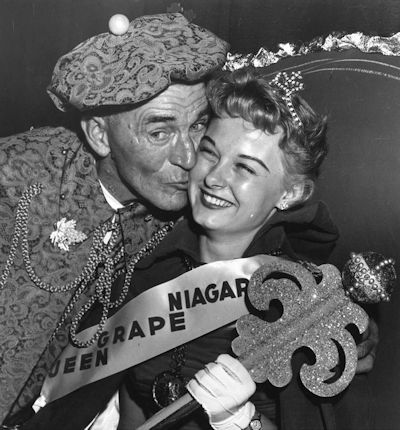


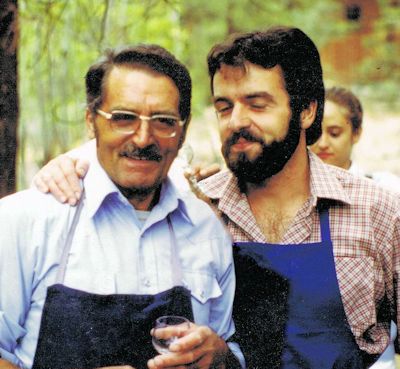


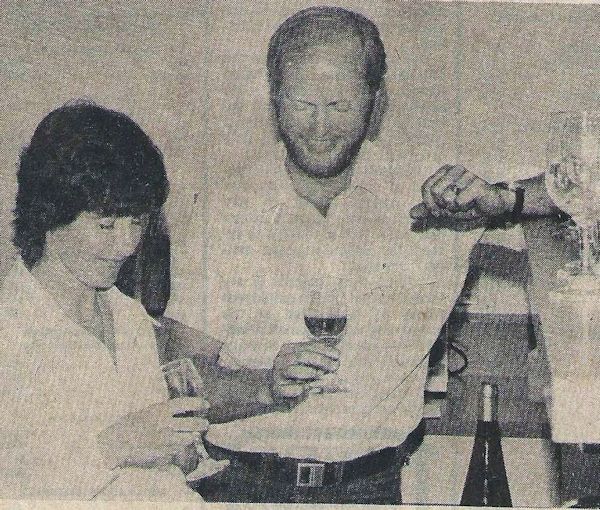
Resources :Niagara's Wine Visionaries - Linda Bramble - James Lorimer - Company Ltd
Okanagan Wine Tour Guide - John Schreiner - Whitecap
The Wines of Canada - John Schreiner - Mitchell Beazley Classic Wine Library
The Wineries of British Columbia - John Schreiner - Whitecap
Icewine The Complete Story - John Schreiner - Warwick Publishing
Canada Wines for Dummies - Tony Aspler, Barbara Leslie - CDG Books
The Tangled Vine: Wine Growing in Nova Scotia - Chris Naugler MD, Bruce Wright. MD, Robert Murray PAg.-blue frog inc.
Nova Scotia Historic Society
Clair House, Cooksville and the Beginning of the Ontario Wine Industry- Richard A Jarell
Rittich, V.J.: European Grapes for the Okanagan. Text of address in author's files.
Parks Canada Agency - Historic Places
Wines of Ontario - William F Rannie
Institute of Italian Studies-Lakehead University
Vera Klokocka and Family
The Vinedressers by Ron Tiessen Pelee Island Heritage Centre
Richard A. Jarrell
Chateau Clair, Canada’s First Vineyard & Commercial Winery By Matthew Wilkinson Historian, Heritage Mississauga
Ontario Grape Growers.
Lynn Bremmer
Wines of Eastern North America - Hudson Cornell
The World of Jules Robinet 11 by Jack Cecillon
Elais Phiniotis -Winemaker / Consultant
Notes and information supplied by:
John Schreiner
Terry Matz
Chateau des Charmes Winery
Klokocka Family
London Library
Helen Fisher, researcher
Robert Murray, researcher
Irene Gammon - great granddaughter of Jules Robinet
Donald Triggs
Roger Walsh
Donald Ziraldo
Wild Goose Vineyards
Elias Phiniotis
Hender Estate Wine
information welcome
History | Home | About |Sitemap | Gallery | Contact | ©2022 Robert A Bell